Thursday, February 6, 2020

The 9 Best Books on Writing That’ll Help You Master Your Craft

Admit it.

You have several half-read books on writing stacked up on your nightstand, several more squirreled away in a desk drawer and a dozen more on your Amazon wish list.

You scrutinize all the books that “customers also bought” looking for those one-of-a-kind books that will transform you into a great writer. You jump “inside the book” to read the table of contents and credits and page through the free preview.

Searching for the magic formula.

The formula that will erase the silent self-doubt. The nagging thought that you’re not quite good enough as a writer.

Books have an uncanny power to teach us, to transport us, to move us light years beyond our ordinary lives. If we could only find the right books, the tried-and-true books written by trusted masters. So we keep looking.

And once in a while you find a writing book that speaks to your heart and gets to the core of what you’re struggling with right now. It changes you. It changes your writing. It changes your life.

Because mastering the craft of writing depends upon your continuing education as a writer. It means you regularly upgrade and fine-tune your skills.

The 9 Best Books on Writing That’ll Help You Master Your Craft

The 3 Critical Disciplines You Need to Develop as a Writer

1. Brutal Honesty

First, you need to cultivate a brutal, raw honesty. You need to accept that not every power word, every emotional thought, every first draft, every adjective-loaded sentence that flows from your hot fingertips is precious.

I mentored many rookie reporters who had a cocky, almost swaggering pride at where their writing skills landed them out of college. A few weeks in a newsroom with a couple of crusty copyeditors exploded that attitude. Then, they were ready to listen.

Objectively, unemotionally and dispassionately analyzing your writing is one of the most valuable skills you can develop to further your writing opportunities. And as a side benefit, you’ll also be able to handle scathing criticism from ruthless editors.

2. Linguistic Appreciation

Secondly, you need to develop an ear and eye for the flow of language.

Good writing has a rhythm, that deliberate cadence the writer creates in your mind as you read. Marvel at the perfectly placed and exquisitely balanced use of illusion, surprise and metaphor, and crave to imitate it.

Because if you don’t learn to appreciate the music and poetry in other writers’ work, you’ll never cultivate it in your own work.

3. Insatiable Curiosity

Thirdly, you have an insatiable desire to learn anything and everything to improve your writing, the openness to accept constructive criticism and the commitment to sit with your bloated prose and edit until it sparkles.

Yes, writing is a solitary craft. And learning to improve our writing can feel like solitary confinement without guidance and reassurance. We can learn from teachers, from workshops, from books, but ultimately success is up to us, alone with our notepad or laptop.

The 3 Types of Books You Need to Grow as a Writer

There are three broad types of books about writing:

  • Books that teach the mechanics of language – style, grammar, editing, etc.
  • Books that teach story structure – how to structure your thinking, your frame of mind and approach, and structure a story or other particular literary form.
  • Books about being a writer – how to navigate the unique inner life of a writer.

Of course, most writing books will touch upon each type of writing advice. But to improve your writing skills in the fastest and most effective way, you must understand what you need to grow as a writer right now and choose the appropriate book to help.

The 3 Stages of Writer Development (and What to Read Based on Where You’re At)

We have writers of all levels of experience and ability reading Smart Blogger and in our GuestBlogging training program and Serious Bloggers Only community. They typically describe themselves in one of three stages:

1. The Novice Writer

You’re a brand-new writer who felt an inner switch flip on, and now a river of ideas is pouring out of your head. You know your writing needs work – lots of work – but you are compelled to keep writing because you feel powerless to staunch the flow. And even if you could stop, you wouldn’t want to.

What to read: Ideally, you should be reading both books on mechanics and structure. But the books on the mechanics of language will likely bore you to death right now. It’s far better for you to learn structure and good thinking habits early, and work on the mechanics later.

Think of it from an editor’s point of view: A poorly written but well-structured piece of writing can be polished. A poorly structured and poorly written piece is a nightmare, and rarely worth the editing effort it demands. The writer doesn’t understand his topic, hasn’t thought it through with clarity and is clueless on how to engage the reader.

2. The Competent Writer

You’re a decent writer and have lots of ideas, but you often aren’t sure where to begin. If you’re honest with yourself, your writing is okay with occasional stellar moments.

What to read: Start with books on approach and plot structure that will help you think through your ideas before you put them on the page. Often, with good writers, the best writing happens in your head before you even jot down a sentence.

If you’ve been writing in a certain style or format for a while — such as blog posts — cross train in another genre. (More on this later.) Study the structure of screenwriting, novel writing or poetry for six months or until it feels nearly second nature to shift into this new form. The change in your writing will be dramatic and permanent.

Once you’ve improved structure and approach, pick one or two mechanical fixes to work on as you rewrite and edit with your new eyes.

3. The Seasoned Writer

You’ve written a lot for a long time and have the mechanics mastered. But your writing experience has been centered in business, academia, medicine, law or other utilitarian venues. You’re ready to write fiction, or use the life lessons you’ve learned to help others through your blog, but you’re struggling to share your own ideas in your own voice. You recognize that your writing is solid, but it lacks warmth and sparkle.

What to read: Immerse yourself in books about being a writer and the writer’s life. Leisurely read some memoirs from writers who have traveled around the world, from New York to France, and you’ll be startled by how similar your doubts and struggles are. Try on a few silly new rituals, like writing poetry by candlelight or stream-of-conscious journaling in the pre-dawn hours to change up your point of view.

How to Know Exactly Which Books to Read First

Before we dive into our list of essential books, let’s talk briefly about the best way to use it.

If one of these writing stages resonated strongly with you, jump down to our favorite books in the three categories below and start there. If you’ve already read our favorites, you might want to read them again with a fresh mind and notebook handy.

If you don’t feel you fit neatly in one of those stages, grab the book that excites you the most, right now, as you read about it here. The one that jumps up and gently taps you on the cheek like a hungry cat to get your attention.

Start there and take the time to import the ideas and writing exercises into your current work immediately. Thinking about it won’t make it so; you must put these concepts into practice. Even 30 minutes a day will make a noticeable difference in a short time.

“The art of writing is the art of applying the seat of the pants to the seat of the chair.”
— Mary Heaton Vorse

The Best Books on Writing (and the Only 9 Books on Writing You’ll Ever Need)

Think about this: in the next hour, you have the ability at your fingertips to tap into the world’s best books on writing and begin the next stage of your transformation – if you’re willing to make the commitment of time.

The following books will make the difference, and each is around $10 on Kindle or less, so download and begin.

Books on Mechanics of the Language

On Writing Well: The Classic Guide to Writing Nonfiction by William Zinsser
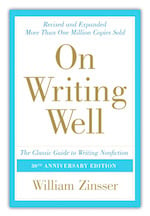
On Writing WellFavorite: Best book on the mechanics of the language

I was fortunate to find On Writing Well while I was working at my first newspaper and realized my editors, excellent grammarians all, could not teach me anything more about significantly improving my writing. This one book changed the trajectory of my career as a journalist from a mediocre, but promising, community reporter at a large twice-weekly paper to an international business reporter at a respected metropolitan business paper.

Originally published in 1976, Zinsser’s writing tips on mechanics, structure and thinking have stood the test of time for generations of writers of all kinds. His principles are equally sound for today’s bloggers, fiction and non-fiction writers and any kind of digital publisher.

The Elements of Style by Strunk and White (William Strunk Jr. and E.B. White) is another great one, but On Writing Well was always my go-to.

Categories: Primarily mechanics but interwoven with thinking and structure

What’s in it for bloggers: If you read only one book on improving the structure and mechanics of language, make it this one. An added benefit: You’ll learn a lot from Zinsser’s easy, conversational writing voice that you can apply to your own blog.

Books on Structure and Frame of Mind

Save the Cat by Blake Snyder

Save the CatFavorite: Best Book on Structure

Save the Cat is essentially a formula book, focused on the structure of screenplays. It’s similar to Story Engineering (below) in that it explains the structure and elements of a screenplay, but is more approachable. Think of it as an introductory college course that teaches you the basics.

You’ll learn the main story archetypes, how to structure a good screenplay, and more subtle techniques like how to create a character the audience loves almost immediately.

One of Jon’s favorite writing books, you’ll be able to write a decent screenplay with Save the Cat if that’s your goal. He calls it “Headline Hacks for storytelling – fill in the blanks.”

Categories: Primarily structure and formula

What’s in it for bloggers: A blog is a performance and you’re the main character. Learn how to make an audience fall in love with you.

Story Engineering: Mastering the 6 Core Competencies of Successful Writing by Larry Brooks
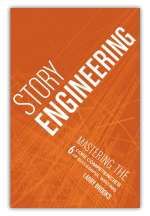
Story Engineering - Larry BrooksCompelling stories are the undercurrent that propels successful writers and bloggers of all kinds. Whether you are writing blog posts, e-books, magazine articles or novels, having the skills to deftly tell a story will make you both memorable and in-demand as a writer.

Story Engineering is like a master class in storytelling and novel writing. It focuses deeply on the six core elements – or competencies – of successful storytelling, screenplays and novels. An intense, comprehensive book, Story Engineering can help bring your writing to a professional level if you read and consistently apply the concepts in this book.

Categories: Heavy on structure

What’s in it for bloggers: You can master the structure of a good story with this book, whatever topic, niche or length you write. And get all your questions answered about storytelling in one place. It’s worth the time and effort.

Naked, Drunk and Writing: Shed Your Inhibitions and Craft a Compelling Memoir or Personal Essay by Adair Lara
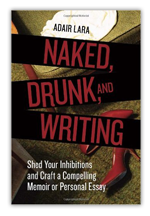
Naked Drunk and Writing - Adair LaraWhile at first glance this book looks like it has nothing to do with how to start a blog or blogging in general, learning how to craft a compelling personal essay is the essence of what most bloggers struggle with today. Whether or not you realize it, you are parading yourself naked and drunk every time you hit “publish” in WordPress.

Naked and Drunk is about two-thirds biographical and about one-third writing lessons. It weaves together Lara’s personal stories with lessons on how to structure a memoir with lessons and language mechanics.

This is the book you also want to read if you want to learn to effectively tell your own story. But don’t read it first.

You need to understand the elements of crafting a good story to fully appreciate and benefit from the lessons in Naked and Drunk. Read it after the storytelling books. Read it after you read Save the Cat.

Categories: Primarily structure with some mechanics

What’s in it for bloggers: You’ll discover how to see beyond the label “blogger” and craft your story to touch the lives of readers.

How to Write a Damn Good Novel: A Step-by-Step No Nonsense Guide to Dramatic Storytelling by James N. Frey
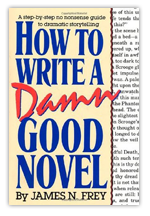
How to Write a Damn Good Novel - James FreyDamn Good Novel is similar to Save the Cat in that it offers a structure and formula for constructing a novel, but it’s filled with more principles of good writing and examples of excellent storytelling.

If you haven’t figured out by now, structure and storytelling are critical skills to becoming a successful, or even merely competent, writer. The more you can learn about storytelling in all its forms, fiction or non-fiction, short stories or long, the more tools you have in your writer’s toolbox.

With tens of thousands of new blogs created every day, according to WordPress.com, compelling storytelling is the one proven method of setting your writing apart from the masses.

Categories: Primarily structure and storytelling

What’s in it for bloggers: This is cross-training in storytelling. Don’t guess, don’t try to make it up and don’t waste time reinventing the wheel. Learn it; then make it work for you.

CA$HVERTISING: How to Use More than 100 Secrets of Ad-Agency Psychology to Make Big Money Selling Anything to Anyone by Drew Eric Whitman
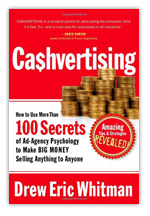
Ca$shvertising - Drew Eric WhitmanTitle turn you off? Too money-grabbing for you? Skip this copywriting book at your blogging peril.

Face it: Successful blogging is persuasive writing in another suit of clothes. It doesn’t even matter if you want to make money from your blog or not. You need to connect with people (through stories) and persuade them you have a message worth reading or products worth buying (through copywriting).

Jon recommends this book for most bloggers because it has the most modern approach and best summary of the key points covered in the fundamental copywriting books.

Categories: Structure and using the mechanics of language

What’s in it for bloggers: Whether you’re a beginner or more experienced writer, take the time to learn what successful bloggers know about using psychology in your writing. At least, it will open your eyes to how you respond to the persuasive writing all around you without even knowing it.

Books on Being a Writer

On Writing: A Memoir of the Craft by Stephen King
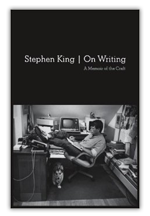
On Writing - Stephen KingFavorite: Best book on being a writer

Even if you’ve never read any of King’s gory thrillers, this book is a must-read. Then reread it at least once a year.

Very much a memoir, King uses stories of his wild childhood to illustrate the making of a writer. Besides memorable stories, you’ll get insight into structure, key takeaways on mechanics and his opinions on what’s important to writing and writers. You get to peer inside his head and see how his mind formulates those bizarre ideas and crafts unworldly plots. You’ll be both awed and inspired to suddenly see story elements all around you.

Categories: Primarily writing life with a frame of mind and structure insight

What’s in it for bloggers: The craft of storytelling to engage readers and keep them coming back for more (from the author of more than 50 worldwide bestsellers), and how to constantly think about what your readers are thinking so you can crawl inside their heads and freak them out.

Bird by Bird: Some Instructions on Writing and Life by Anne Lamott
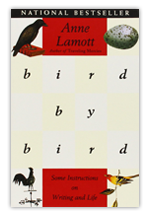
Bird by Bird - Anne LamottLamott’s small book may be one of the best-loved on how to structure your writing frame of mind and the writer’s life. She so adeptly and invisibly reflects her thoughts and experiences back on the reader that you feel an intimate part of her personal stories – a rare and long-acquired storytelling skill.

This is another book to read at least once a year. And along with King’s On Writing, to copy by hand on paper to absorb some of the rhythm, cadence and magic of these classics.

Categories: Being a writer interwoven with frame of mind and approach

What’s in it for bloggers: Lamott could be a role model and idol for bloggers who want to use their personal stories to illustrate fundamental truths about life. You’ll so resonate with her stories, you won’t even notice when she talks about herself.

Writing Down the Bones: Freeing the Writer Within by Natalie Goldberg
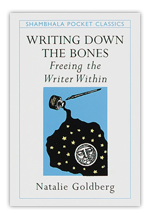
Writing Down the Bones - Natalie GoldbergGoldberg’s fresh observations will reintroduce you to the wonder, magic, curiosity and excitement that lured you into writing in the first place. Although published nearly 30 years ago, Goldberg would be a hugely popular blogger today if she filled a blog with her Zen-inspired posts on how to be a writer, how to beat procrastination, the beauty of language and how to be focused and spontaneous at the same time.

Back in my newspaper days, I read from the chapter, “Man Eats Car,” when asked to talk to elementary school classes about creative writing. Inspired by Goldberg’s example, I once wrote poems on demand for $1 during a church festival. Children stood there and stared at me, wide-eyed, as I wrote poems on their ideas – ballet, wrestling, the rain – in the pen color of their choice.

Categories: Frame of mind and being a writer

What’s in it for bloggers: If you need something gentle to jar you out of writer’s block and your same-old-same-old writing rut while inspiring you to see the world with fresh eyes, read this book.

Read Your Way to Becoming a Better Writer

Your writer’s education is never complete.

And if you stay curious, the world is a generous writing teacher.

Every day, your mental kaleidoscope is filled with images and impressions you can use to create mesmerizing stories.

Books can bring structure and insight, but the constant search for exactly the right book keeps you from the job at hand – the act of writing.

So call off your search and focus on the nine books mentioned here.

Start by asking yourself a question:

“What do I need as a writer – right now?”

To sharpen the tools of your trade? Grab Zinsser’s book.

To get practical advice and fresh inspiration on life as a writer? Pick up King, Lamott or Goldberg.

To learn a proven creative process for structuring your writing? Read Save the Cat.

That you start is more important than where you start.

So get reading. Pick a book and start.

And then get writing. Because that’s what real writers do.

About the Author: Marsha Stopa is senior instructor and coach for all Smart Blogger courses. She’s living her dream in the Blue Ridge Mountains in western North Carolina, where she just bought a fixer-upper among the bears on a quiet mountain with a stunning view

The post The 9 Best Books on Writing That’ll Help You Master Your Craft appeared first on Smart Blogger.


from
https://smartblogger.com/essential-writing-books/

Tuesday, February 4, 2020

How to Boost Your YouTube Strategy With Bumper Ads [Infographic]

Video's popularity has exploded, leading to YouTube's becoming a massive search engine. Chances are, your customers--and potential customers--are conducting searches there associated with the products or services you or your competitors offer. That's where YouTube bumper ads come in. Read the full article at MarketingProfs

from
https://www.marketingprofs.com/chirp/2020/42392/how-to-boost-your-youtube-strategy-with-bumper-ads-infographic

Friday, January 31, 2020

Perfectionism Can Be A Good Thing! [PODCAST]

You’ve been told perfectionism is bad, to let things go, and to stop obsessing over details.

But…

Aren’t the best artists obsessed with quality? How do you release really good work without becoming the bad type of perfectionist?

In this episode, I’ll show you how.

Where to Subscribe

How You Can Support the Podcast

Leave us a Review

The more reviews we receive on Apple Podcasts and iTunes, the more listeners we’ll get to reach (thanks to Apple’s fancy algorithm).

If you don’t know how, click here for detailed, step-by-step instructions that’ll show you how to leave us a review on Apple Podcasts and iTunes.

Tell Your Friends & Family

Have friends or followers you believe would enjoy the podcast? Email them a link to this post. You could also…

Tweet This Episode:

In this week's podcast episode, Jon Morrow teaches us how to release really good work without becoming the BAD type of perfectionist.Click To Tweet

The post Perfectionism Can Be A Good Thing! [PODCAST] appeared first on Smart Blogger.


from
https://smartblogger.com/podcast-perfectionism-can-be-a-good-thing/

Thursday, January 30, 2020

Grammarly Review: Is it the Best Grammar Checker in 2020?

So reading a Grammarly review is now a priority after that embarrassment.

The one that made you realize “yeah, getting a grammar checker might be a good idea.”

You reviewed your email carefully.

Then you hit send.

And only then did you see it. The error your eyes skimmed right by. Buried in the middle of your text, you missed it, but now it flashes out at you, and it is all you can see.

Grammarly (affiliate link) could prevent the pain of those mistakes.

It’s the secret weapon smart writers use every single day to make their writing error-free, polished, and clean as a whistle.

Let’s jump in and learn more.

Grammarly Review: Is it the Best Grammar Checker?

What is Grammarly (and How Does it Work)?

Grammarly is an “AI-powered writing assistant” that helps you improve your writing.

It goes well beyond a basic spell checker. It uses the latest in artificial intelligence to apply English language conventions and grammar rules to your work.

Grammarly proofreads your beautiful words and alerts you to errors that can detract from your message.

As you type, Grammarly provides real-time feedback, informing you of mistakes, and makes suggestions to fix them. You can quickly correct issues as you create your messages.

Real-time feedback

The best part of this?

Grammarly gives you an explanation of the reasons behind the correction. This allows you to learn from your grammar errors, so you stop making them.

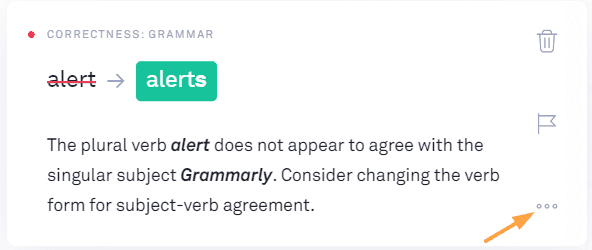
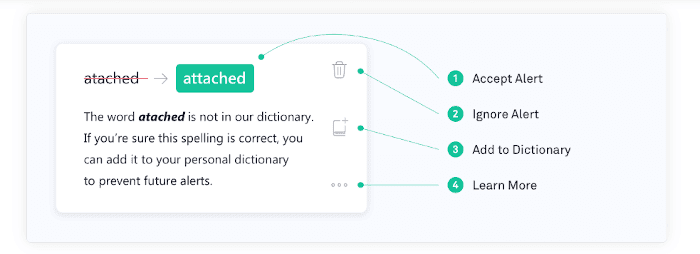
Simply click on the three-dot ellipse to reveal the explanation:

Grammarly Review: explanation example

This explanation can be invaluable. And if you need to brush up on your grammar skills, Grammarly provides a handbook of grammar rules for easy reference.

In each case, you make the decision whether or not to accept the correction. You remain in control of your writing.

True, Grammarly can’t replace a human proofreader, but it will catch a wide range of mistakes and errors. It isn’t perfect, so you always want to use your own judgment and think through the suggestions. Don’t blindly accept them.

Where Can I Use Grammarly?

Grammarly works almost everywhere you do — you can use it on your computer or your mobile devices. Whether you want to text, post on Facebook, tweet, comment on blogs, or write a blog post, it can be there for you.

To do this, Grammarly is available as both an app and as a browser extension in Chrome, Safari, Firefox, and Internet Explorer.

Here are a few of the platforms it works on:

  • Email (Gmail, Outlook)
  • Documents & Projects (Google Docs, Microsoft Word, Slack, Salesforce)
  • Social media posts (Facebook, Medium, Twitter, LinkedIn)
  • Websites (including backend web pages in WordPress)

So How much Does it Cost to Use Grammarly?

The free version of Grammarly won’t cost you a penny. It’s completely free.

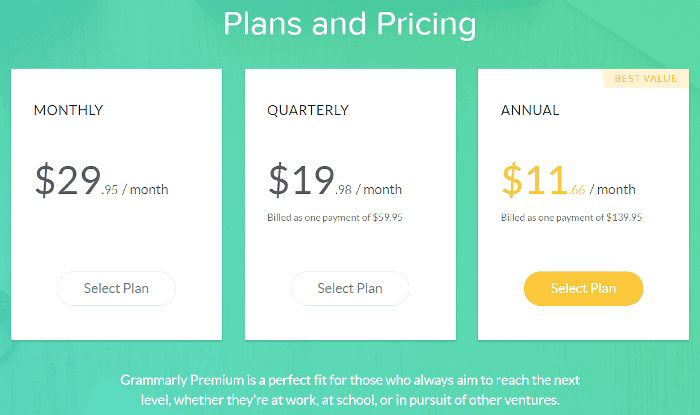
But if you need more features, here are the prices for Grammarly Premium (as of this writing):

  • A monthly subscription is $29.95 per month
  • A quarterly subscription is $19.98 per month (billed as one payment of $59.95)
  • An annual subscription is $11.66 per month (billed as one payment of $139.95)

Grammarly Review: breakdown of prices

Is the premium version of Grammarly worth the upgrade?

Let’s take a look…

What are the Differences Between Grammarly Premium and the Free Version?

The free version of Grammarly offers corrections for spelling errors and basic grammar mistakes. It does a great job of preventing typos.

The premium version offers advanced writing feedback.

It watches for advanced grammar mistakes and contextual spelling errors. It also suggests improvements in sentence structure, word choice, and style.

Grammarly Review: example of suggestions

Overall, the free version is okay for casual writing. But for longer-form or professional content that you need to be its absolute best, you’ll want to consider Grammarly Premium.

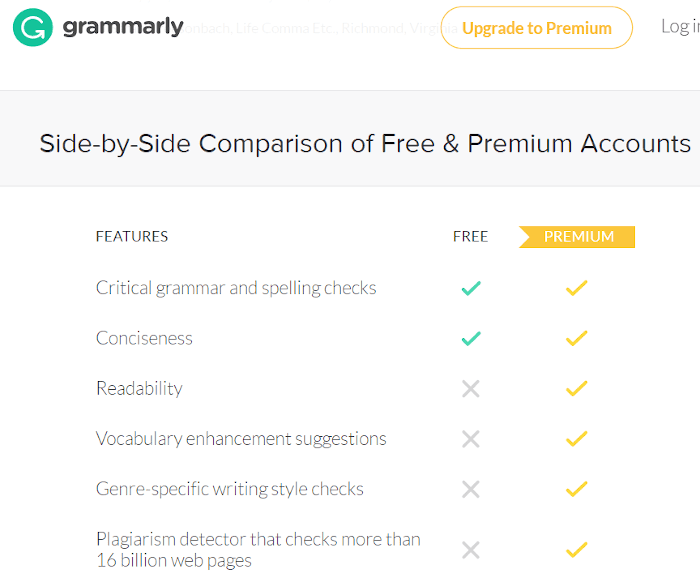
Here’s Grammarly’s side-by-side comparison:

Grammarly Review: free vs. premium comparison

Let’s go over the extra features you get with Grammarly Premium:

Advanced Grammar and Punctuation Checks

The premium version offers additional grammar and punctuation functionality. A few examples are:

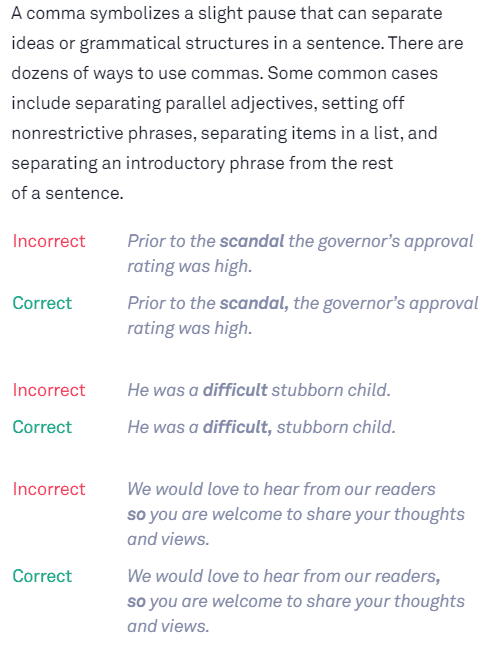
  • Punctuation errors such as either missing or unnecessary commas, or comma splices.
  • Sentence structure issues like missing verbs, incorrect adverb placement, or faulty parallelism.
  • Style errors, for example, using the passive voice, or colloquial phrases in a formal document.

Grammarly Premium says it runs 400+ checks on your writing!

“Readability” (Or, What Are You Trying To Tell Me?)

Readability is the difference between a reader enjoying your writing or quitting in frustration.

A high readability score means a piece of writing is easier for a reader to understand — the higher the score, the easier it is to read. It’s important because you don’t want to exhaust your reader with lengthy sentences and lots of complex words.

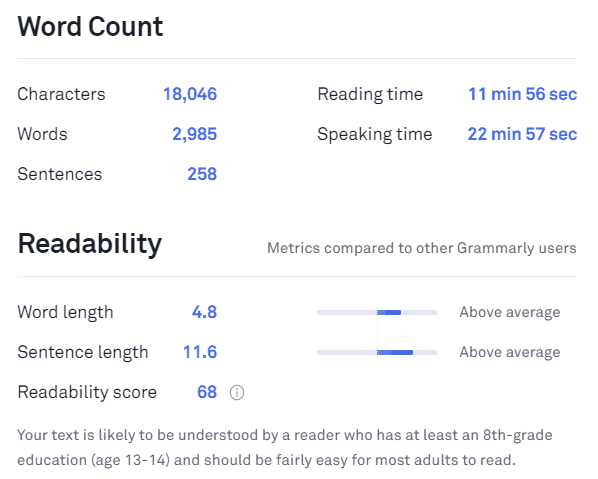
Grammarly uses the Flesch reading-ease test to measure readability. For most writing, you want to aim for a score of 60 or higher. This means that people with at least an eighth-grade education would find it easy to read.

Grammarly provides a handy report to provide this readability score along with your average word and sentence length.

Readability example

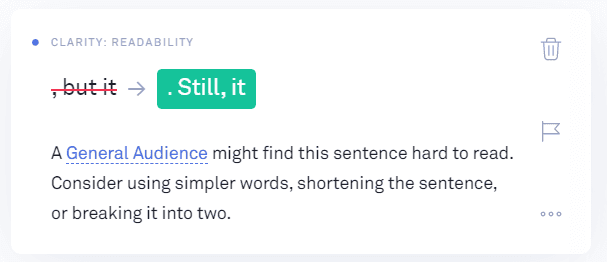
To help you improve the numbers on this report, the premium version of Grammarly will flag overly long sentences. It will also suggest simpler words where appropriate.

“Vocabulary Enhancement Suggestions” (Or, Improve Your Vocabulary)

Grammarly Premium will offer you alternatives for either overused words or weak adjectives.

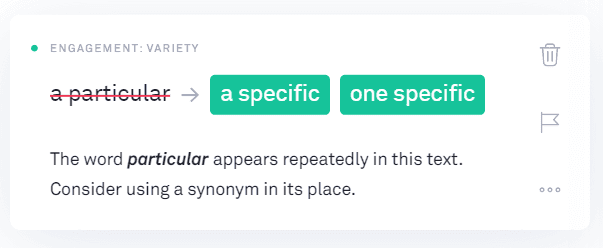
It will alert you if you use a particular word over and over again, and it will offer substitutions to keep your writing engaging.

Grammarly Review: subsitutions

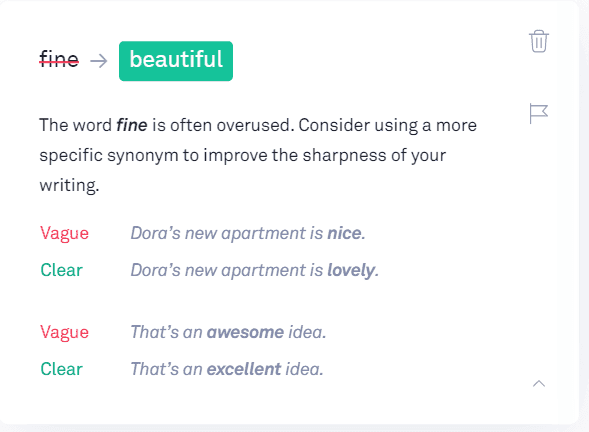
If you use a weak adjective like “fine,” it will suggest you replace it with something more dynamic.

Grammarly Review: example of a suggestion

“Genre-specific Writing Style Checks” (Or, Set Writing Goals)

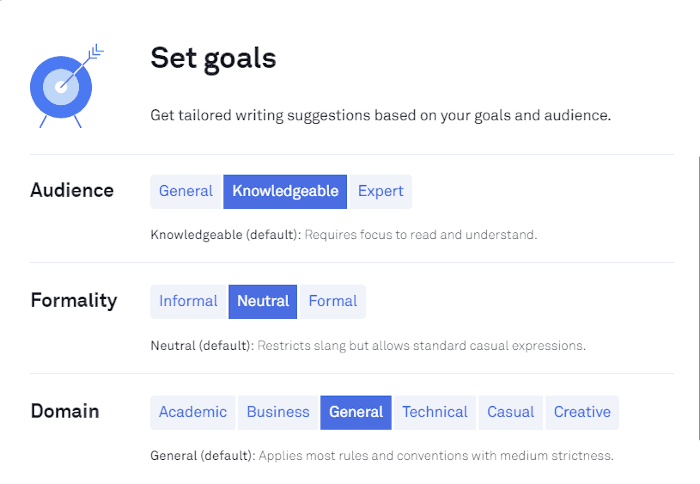
Are you looking for an inexpensive writing coach? Then use Grammarly Premium to get “tailored writing suggestions based on your goals and audience.”

Here are some of the goals you can set for each piece of writing:

Audience (General, Knowledgeable, or Expert)

You want to write for the level of your audience, and you can set this goal to reflect that.

For example, for a general audience, anyone should be able to read your work. At the expert level, you can use longer sentences and words (like medical or technical terms).

Formality (Informal, Neutral, or Formal)

As an example, in blog writing, you can begin sentences with a preposition. But if you are writing a paper for a more formal audience, you’ll want to use by-the-book grammar rules. This allows you to toggle between sets of grammar rules.

Domain (Academic, Business, General, Technical, Casual, or Creative)

The domain you select will have to match the options in Formality. For example, if you choose Academic, the Informal option is unavailable.

Formality example

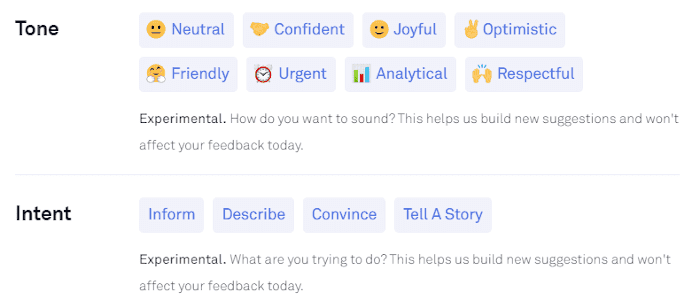
The next two goals for Tone and Intent are experimental but fun to use:

Tone example

Plagiarism Checker

One of the main benefits of Grammarly Premium? There are unlimited plagiarism checks. You can check your text as obsessively as you’d like, no extra charge.

If you read a lot and have a decent memory, you are in danger of accidental plagiarism. You may write what you believe to be an original thought, but nope, it isn’t. Using a plagiarism checker is vital!

You might inadvertently plagiarize by copying and pasting research text into your document, intending to label it properly later. Then the doorbell or phone rings. Life happens.

You come back to your writing and use the snippets of text, forgetting that it isn’t yours and failing to give credit to its creators. A giant oops.

One precaution is to never copy and paste research text into your final document. Always keep it separate and clearly labeled.

If you want to create a citation for a chunk of text, Grammarly provides the options to cite it using either MLA, APA, or Chicago Manual of Style.

Select the convention you want to use, and it will generate the citation for you and add it to your document.

Grammarly also provides links to the appropriate citation generator website if it can’t automatically generate a citation on its own.

In short:

Before you hit publish or submit a new document to your editor, you should run a plagiarism detector to verify your text is truly original.

And Grammarly Premium makes this possible.

Vital Feedback To Improve Your Writing

The best reason for paying for Grammarly Premium is it helps you to become a better writer by telling you why it is flagging an error. It gives you the reasons for your mistakes so you can learn and improve your writing skills.

You cannot become a better writer without feedback.

For example:

Grammarly Review: feedback example

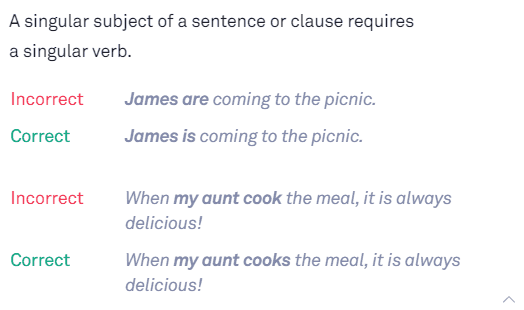
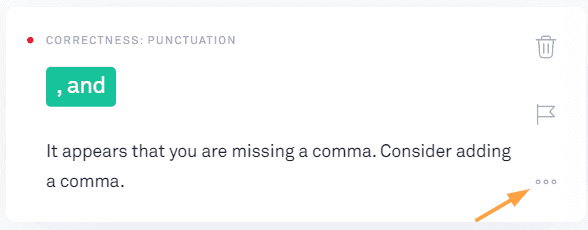
Click the three dots on the correction card to learn more about why this is being flagged as an error, and you’ll see this:

Grammarly Review: error example

I was the queen of forgetting the Oxford comma, a grammar convention that can help prevent ambiguity. After months of fixing it, guess what, I finally have it drilled into my head to use it!

If you pay attention to the reasons for your errors, over time, both your grammar and your writing ability will improve.

Again, always use your judgment. Look things up if something doesn’t look or sound correct. Use this as a learning tool, but remember there is no replacement for brushing up on your grammar.

Which Grammar Checker is the Best?

There are numerous grammar checker options out there for writers — Gingerly, Hemingway, After the Deadline, WhiteSmoke, LanguageTool, and ProWritingAid among them.

Here are a few reasons we believe Grammarly is the best:

Grammarly is Fast and Accurate

Grammarly can process large amounts of text quickly and accurately. For example, it took only a few seconds to run through a 7,000-word post.

It is also known for catching the highest quantity of errors compared to its competitors.

Grammarly is Super Easy To Use

Grammarly reduces the friction in using grammar checking software by making it as easy and as accessible as possible.

Take a minute or so to install the browser extension, and you are off and running. Almost everywhere you communicate on the web, Grammarly will help you keep your writing mistake-free.

If you create longer text for review, no problem. Log in to use the Grammarly Editor online or download the app to your desktop. Then you have the option to either copy and paste your text or upload it.

Grammarly has a clean, intuitive interface. No need for tutorials, or to waste time learning software. If you have any questions, there are helpful onscreen question marks to click for pop-up answers.

Grammarly is Available in Multiple Formats

Grammarly allows you to work on the web, on your desktop, or on your mobile devices. Here’s a list of the formats:

  • Grammarly Editor is available as a web-based tool. Log into the grammarly.com website and you’re ready to edit.
  • Grammarly’s Web Browser extension (Chrome extension, Safari, Firefox, and Edge). Download the Grammarly extension and use Grammarly on your favorite websites.
  • Grammarly’s app for desktops is available for either Windows or Mac. It’s one click to access, and you can either upload or copy and paste a document to check it.
    Grammarly add-in for Microsoft Office on Windows. This add-in allows you to use Grammarly while working with Microsoft Word & Outlook. This plug-in is for PCs only, it isn’t currently available for Mac.
  • Grammarly Keyboard for iOS or Android. Download this app to check your writing on mobile devices.

With a variety of options, you can bring Grammarly’s helpful algorithms with you wherever you write.

Grammarly is Customizable

Being able to customize your writing goals for the type of writing you are doing is a powerful feature.

Grammarly allows you to apply the right set of grammar rules according to the kind of work you are doing. Example: casual writing, which allows the bending of rules not acceptable in formal writing.

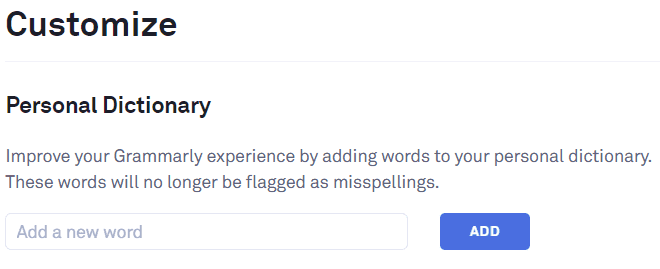
Grammarly also gives you a custom dictionary. If your writing contains brand names, jargon, or abbreviations, you can add them to your personal dictionary. This eliminates constant flags for incorrect spelling.

Custom dictionary example

This is a useful feature, but before you add a word to the dictionary, double-check your reasoning. Adding slang or jargon that works with one piece of writing might not be a good idea to add to your dictionary.

Why?

Because then it’s ignored when you work on something a bit more formal.

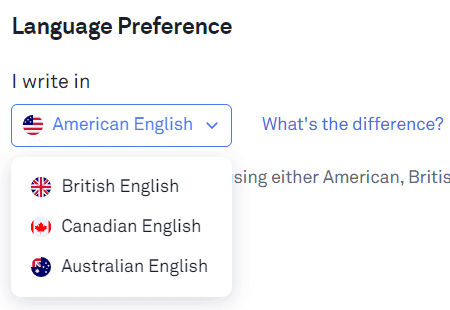
Grammarly also allows you to customize your English Language preference. It distinguishes between American English, British English, Canadian English, and Australian English.

You don’t want to be told to change the spelling of colour to color if you are writing in British English, right?

Grammarly Review: language preference

Grammarly: Frequently Asked Questions

Is Grammarly Premium Worth It?

If your grammar skills are solid and you keep spelling mistakes to a minimum, the free version of Grammarly could be all you need.

But if your skills are lacking, or if you’re a professional or student whose livelihood depends on written communication, Grammarly Premium is well worth it because it’ll catch mistakes that could damage your credibility (or torpedo your test scores).

Is it Safe to Use Grammarly?

Yes, but it depends on how comfortable you are with your information being transmitted online. According to its privacy policy, Grammarly transmits your writing to its online servers. Your text is stored on those servers while Grammarly runs its AI magic on it.

Similar to the precautions you’d take with email, you should be cautious of highly confidential or sensitive documents. Grammarly has many safeguards in place to protect your data, but no company (whether it’s Grammarly or Google) can promise 100% security.

So if you are an employee, you may want to check with your IT department for your company’s data management policies.

And if you are writing something deeply personal and private, you probably don’t want that anywhere near the internet anyway.

In fact, go analog and write it on paper. Then shred it for the ultimate privacy.

Who Should Use Grammarly?

You don’t need to be a professional writer who is paid to write to use Grammarly — anyone who uses the written word to communicate could benefit from it.

After all, if your message contains glaring errors, it’s hard to focus on the message and not the errors, which detract from the message you are trying to get across.

Grammarly is especially beneficial for writers judged on the quality of their written work, such as:

  • Bloggers
  • Content Marketers
  • Copywriters
  • Authors
  • Students
  • Business people who write emails or reports or create presentations.

Is There Anything Better Than Grammarly?

Possibly. It depends on your needs and your situation.

Here are a few Grammarly competitors that provide better options for some users:

ProWritingAid

ProWritingAid is the probably best Grammarly alternative. It is a solid grammar checker with similar features.

It offers in-depth feedback on your writing style by providing over 20 different writing reports. As an example, one of the reports will flags cliches in your writing.

ProWritingAid may be a better choice for fiction writers as it offers reports such as pacing checks for your fiction story.

If you use Scrivener as your primary writing tool, ProWritingAid provides Scrivener integration. You can still use Scrivener with Grammarly, but you will need to copy and paste your text into Grammarly’s app.

ProWritingAid may be a better choice for budget-constrained writers. It costs $70 per year (there are discounts on multi-year licenses), and for an additional $10 per year, you get 50 Plagiarism checks.

Ginger

This online grammar checker may be a better choice if you write in a language other than English. It can translate text between 60 different languages.

The interface is not as easy to use as Grammarly, and it offers fewer features. However, at $89.88 for a yearly subscription, it can work for budget-minded writers.

Hemingway App

The Hemingway App is not a replacement for Grammarly, but it is a useful complement to it. The online version is free, and the desktop app is $19.95 if you’d prefer to work offline (or support the developers).

The goal of this app is to have you write, well, like Hemingway. It provides feedback to help you keep your writing simple and easy to read.

It does this by flagging sentences that are either “hard to read” or “very hard to read.” However, the edits are up to you — it doesn’t provide suggestions to fix the complex sentence structure.

The Hemingway App also flags the use of the passive voice and the use of more than three adverbs in a piece of work. It will alert you to complex phrases and provide a few recommendations for alternatives.

Again, you want to use your own judgment when considering edits. Stay true to your own writing style, as long as it is clear and easy to read.

Does Grammarly Work With Word?

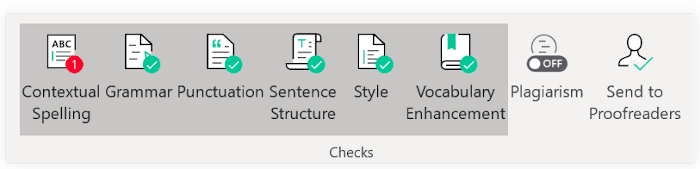
Yes, Grammarly works with Microsoft Word. There is an add-in you can download to your computer (Windows only). Once installed, you can click the Grammarly button on the Home tab, and a Grammarly sidebar will appear.

The sidebar allows you to choose which checks you want to run on your MS Word document.

Grammarly in Microsoft Word

Once enabled, Grammarly checks for errors and suggest fixes.

Grammarly Review: bug fixes in Word

Does Grammarly Work In Google Docs?

Yes, Grammarly works in Google Docs, but as a beta version only.

Gramarly Review: using Google Docs

Even with the Grammarly Premium upgrade, the Google Docs version is limited. For example, it will flag mistakes and provide suggestions for corrections, but it doesn’t give you the reasons for your errors. It’s also missing the suggestions to improve Clarity, Engagement, and Delivery that’s included with the premium version.

It also doesn’t pick up the same amount of “Correctness” errors in Google Docs that it will when you copy and paste the same text to the Grammarly app.

As a workaround, you can make changes to the grammatical errors that are flagged to keep your document as clean as possible. But then you’ll want to copy and paste your work into the web or desktop app to make your final sweep for errors and improvements.

Is Grammarly Really Worth It?

Now that you’ve read this in-depth review of Grammarly, you know the answer.

The free version of Grammarly cleans up typos and prevents embarrassing mistakes. If you are a casual writer who writes mainly for fun, the free version may be enough for you. And for anyone who takes their writing seriously, the premium version is a solid investment.

Grammarly doesn’t replace professional proofreaders. Human proofreaders will catch more than Grammarly can and will pick up contextual errors that Grammarly may miss.

Is Grammarly worth it?

Yes.

Grammarly can clean up and improve your writing so that when you hand it over to a human editor to proofread, it will require a lot less work. And less work for them means it will cost you less.

If you do your own proofreading and editing, the Grammarly Premium plan offers a valuable writing assistant. It helps you keep your writing clear, engaging, and easy to read.

If you aren’t sure about the premium version, try Grammarly for free (affiliate link) first to see how you like it.

Signing up is easy — you’ll only need your email address to get started.

About the Author: Karen MacKenzie is a freelance writer and Smart Blogger Certified Content Marketer. She blends her business and financial experience with a desire to connect with readers in a warm and friendly manner. Go to kmackenziewriter.com if you’d like to hire her for your next project.

The post Grammarly Review: Is it the Best Grammar Checker in 2020? appeared first on Smart Blogger.


from
https://smartblogger.com/grammarly-review/

Wednesday, January 29, 2020

ClickBank: The Brutally Honest, Must-Read Guide for 2020

So you want to make money through affiliate marketing, huh?

You can smell the moolah.

And among hundreds of affiliate marketing networks out there, all promising you a piece of the scrumptious $12 billion pie, one has caught your fancy.

ClickBank.

But there’s a problem.

You’ve heard a lot of good things about ClickBank.

You’ve also heard many bad things.

What’s true? What’s fiction? Can you really make money on ClickBank? How can you successfully navigate the rich but perilous ClickBank waters?

That’s what this post’s about.

An unvarnished look at ClickBank, warts and all.

Let’s get to it.

ClickBank

ClickBank: Q&A

What is ClickBank?

Founded in 1998 in a garage in San Diego California, ClickBank is one of the granddaddies of affiliate marketing networks.

You can make money with ClickBank as a product vendor or affiliate marketer without working like a frazzled cubicle slave.

Here are some staggering numbers about the ClickBank marketplace:

  • 200 million customers spread across 190 countries
  • 87th largest Internet retailer in North America
  • 276 categories and 21562 product listings
  • 6 million entrepreneurs on the platform
  • Over 200 million dollars in annual sales

In short: you can make a killing on the network.

The best part?

Joining a lucrative affiliate program on ClickBank is not labor-intensive like writing for money or making money blogging.

ClickBank is a good option for bloggers and entrepreneurs who wish to promote digital and lifestyle products.

How is ClickBank Different From Other Affiliate Networks?

ClickBank is not your typical traditional affiliate network.

Five good things stand out:

  1. Simplicity. The sign-up process is straightforward. You can sign-up within a few minutes and start trading without complicated paperwork to fill or administrative hoops to jump through.
  2. Inclusivity. Anyone can join the network for free. It’s perfect for beginners who want to learn the ropes of affiliate marketing.
  3. Duality. On most affiliate marketing networks you go in either as a vendor or an affiliate. ClickBank allows you to enter the fray both as a vendor and a marketer so you maximize your earnings.
  4. Large Selection. With thousands of dazzling affiliate products in every conceivable niche to choose from, your affiliate program choices are numerous.
  5. Good Commission Rates. ClickBank pays high commissions of up to 75% or even 100%. Plus, they pay fast so you won’t have to wait long to splurge on that you-know-what you’ve had your eye on.

However, there are cons as well:

  • Slow Customer Service. Some reports from the Better Business Bureau claim ClickBank may take up to 7 days to respond to customer emails.
  • Charges on Dormant ClickBank Accounts. You are charged $1 per day after 90 days of no earnings, $5 per day after 180 days of inactivity, and a hefty $50 per day after 360 days of no sales.
  • Some Junk Products. More about how to overcome this in a bit.
  • Fierce Competition for Quality Programs. A good problem to have, if you ask me.

What are the Sign Up Requirements for ClickBank?

ClickBank is free for anyone, both new affiliates and old, to join.

All you need to join is:

  • Live in an eligible country
  • Enable cookies in your browser
  • Have a Tax ID or Social Security number (if you live in the U.S.)

If you plan to register as a vendor, you must pay a one-time activation fee of $49.95. You pay only $29.95 for any additional accounts.

What Affiliate Programs are Available with ClickBank?

Whether you are a tentative newbie who wants to dip a toe into this make-money-online thing or a veteran who wants to grow her earnings, ClickBank has got you covered.

There are many affiliate programs and product categories to choose from:

  • Arts & Entertainment
  • As Seen on TV
  • Betting Systems
  • Business/Investing
  • Computers/Internet
  • Cooking, Food, & Wine
  • E-Business & E-Marketing
  • Education
  • Employment & Jobs
  • Fiction
  • Games
  • Green Products
  • Health & Fitness
  • Home & Garden
  • Languages
  • Mobile
  • Parenting & Families
  • Politics/Current Events
  • Reference
  • Self-Help
  • Software & Services
  • New Age & Alternative Beliefs
  • Sports
  • Travel

Not sure where to start? No worries.

Dan Brock, of Deadbeat Super Affiliate, reveals seven hot niches you can try in this video.

What are ClickBank’s Payment Methods?

With ClickBank, you can receive payments in four different ways:

Payment Method #1: Check

The good old paper check is the default payment option. It’s mailed to the address listed in your account.

Payment Method #2: Direct Deposit

ClickBank offers direct deposit in the U.S. and other select countries at no extra charge. Direct deposits take 1-2 business days to reach your account.

Payment Method #3: Wire Transfer

You can receive payments by wire transfer. This option is for countries not covered by international direct deposit. Payments take up to 5 days (depending on where you live).

Payment Method #4: Payoneer

You can also get paid using the Payoneer Mastercard, an international money transfer service you can get for free. Payoneer allows you to open a U.S bank account where your money is deposited.

As you see, ClickBank gives you a lot of options. Plus:

ClickBank doesn’t tie you to the payment method you’ve chosen.

You can change your payment method at any time. It’s your money, so you receive it your way. But, it may take up to seven days for the new payment method to work.

Whenever you change your email address or password, you can’t switch payment methods for a week. This protects you from fraudsters.

You can set the payment threshold as low as $10.

Is ClickBank a Scam? Or, as the Kids Would Say, is ClickBank Legit?

Is ClickBank an elaborate racket or a genuine business?

Yes, it’s true. Some ClickBank affiliate programs are of low quality. Overhyped junk products are a dime a dozen. But that’s half the story.

There are solid programs on there too.

ClickBank’s like a mega supermarket packed with assorted goods.

Don’t like what’s on the shelf? No problem. Move to another aisle. You’ll soon find what you want.

With a seemingly infinite number of digital products from entrepreneurs all over the world to choose from, your perfect product awaits.

That’s why millions of entrepreneurs are on the platform. Some ClickBank affiliates and vendors have been with them for decades.

But, ultimately, it’s your reputation on the line. You owe it to yourself and your audience to double-check every program before you join it.

Here are some tips to help:

5 Smart Ways Not To Get Burned on ClickBank

To weed out the garbage and uncover the gemstones, follow these tips when choosing a product:

1. Try the product first

You genuinely want to help people, right? Then why not ask for a review sample product from the vendor to see if it’s the real deal. If they say no, buy the product yourself. This way, you’ll be sure of the product’s authenticity.

2. Check the product reviews

Scour through customers’ feedback about the product you intend to sell. Not just reviews by other affiliates because those may be biased. Look for reviews on trusted review sites like Trust Pilot. If the product is popular, it’s likely to have been reviewed somewhere on the web.

3. Check the product’s gravity score

Gravity is the number of affiliates who have sold a vendor’s product in the last 12 weeks. The higher the gravity, the higher the product’s trustworthiness. Each gravity point is an endorsement of the product.

4. Watch out for overblown claims

While it’s possible to make money on ClickBank, it’s not magic. If a program promises you a million dollars overnight while you binge-watch Friends on Netflix, stay away.

They’re fake. They’re tricksters. And they’re out to get you.

Run, and never look back.

5. Be on the lookout for shadowy vendors

Cheats lurk in the shadows. They don’t want to show their faces.

Google vendors that interest you.

Can’t find them? Think twice.

Good vendors have a traceable online history.

Editor’s Note:

These tips aren’t only for ClickBank — smart bloggers and entrepreneurs use them for CJ Affiliate, ShareASale, eBay Partner Network, Amazon Associates, and every other affiliate network.

It doesn’t matter how much affiliate marketing experience you have or how well known the affiliate network is, you need to do your homework.

How Do I Sign Up for ClickBank?

Let’s go through the step-by-step process.

To sign up for an account, go to clickbank.com and click on ‘create account’ on the top right side of the menu.

ClickBank menu

Next:

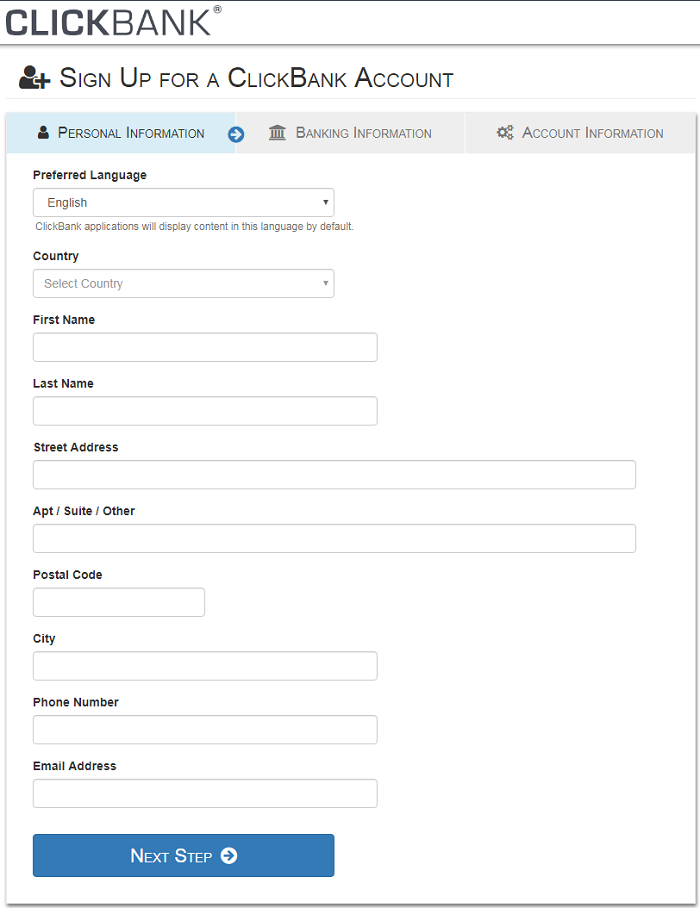
Step 1: Fill in your personal info

ClickBank Account signup step 1

Make sure you complete all fields otherwise you won’t be able to move to the next step.

Click on ‘next step.’

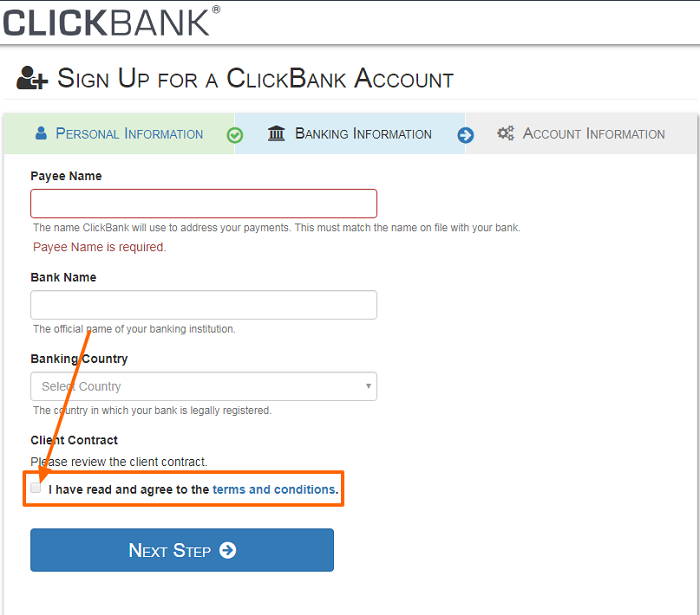
Step 2: Provide your bank details

Remember to check the small box to acknowledge that you’ve read the terms and conditions.

ClickBank Account signup step 2

If you want to be paid through your company enter your business name in the Payee field instead of your personal name.

Your bank info is not used to send payments. That’s why they don’t ask for your account number, just the name of your primary bank.

You pick a payment method after your account is created.

Click on ‘next step’ to move on to the last step.

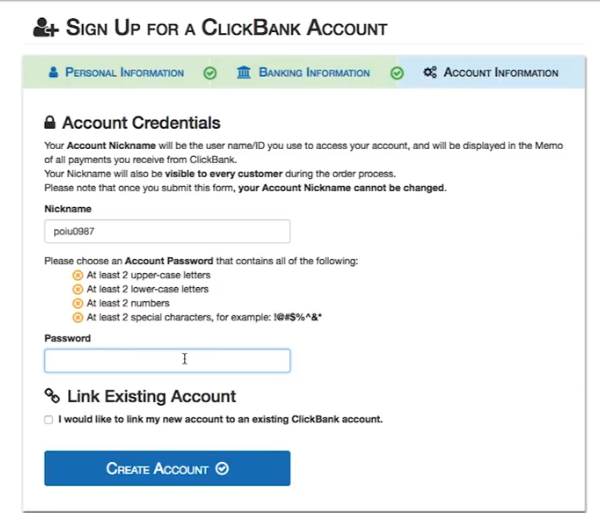
Step 3: Create your account

You’ll then be asked to create a nickname.

Your nickname is your user ID. It’s visible to all customers, so don’t make it too personal.

ClickBank signup stage 3

Affiliate marketing strategy expert Warren Wheeler shares a little-known but powerful secret you can use when creating your ClickBank user ID.

The last step is creating your password. Once you’ve chosen a strong password, click ‘create account’ to finalize your account.

You’ll see a customer survey page. Once you see it, know that your account is now active.

Congratulations!

You’re now ready to do business on one of the biggest affiliate marketplaces in the world.

How Does ClickBank Work? Crucial Code Terms To Master

Before you begin choosing ClickBank affiliate programs, be sure to familiarize yourself with the language used on the platform.

Here are some key ClickBank terms to master:

  • Gravity – This figure tells you how many affiliates have successfully sold the product in the past 12 weeks. The higher the gravity the greater your chances of succeeding with that program. It’s updated daily and can go up to 600+. A product with a gravity score of at least 50 is a safe bet.
  • Initial $/Sale – This number portrays the average dollar value of an initial sale, excluding rebills, credited to the affiliate.
  • Avg %/Sale – Represents the average affiliate commission percentage for a sale, including both initial and rebill commissions.
  • Avg %/Rebill – Represents the average total affiliate commission percentage for a sale, including only rebill commission, for a recurring billing product.

Your true north? The one metric that should guide you?

Gravity.

Why?

Because it shows you what’s selling now.

All other metrics are secondary.

Most affiliate marketers rush headlong, look for the product with the biggest commission and highest gravity.

That’s the wrong way to go about it.

Here’s how to do it right…

How To Make Money With ClickBank: Unearthing Gem Programs And Sidestepping Rubble

Let’s say you want to sell a health and fitness product.

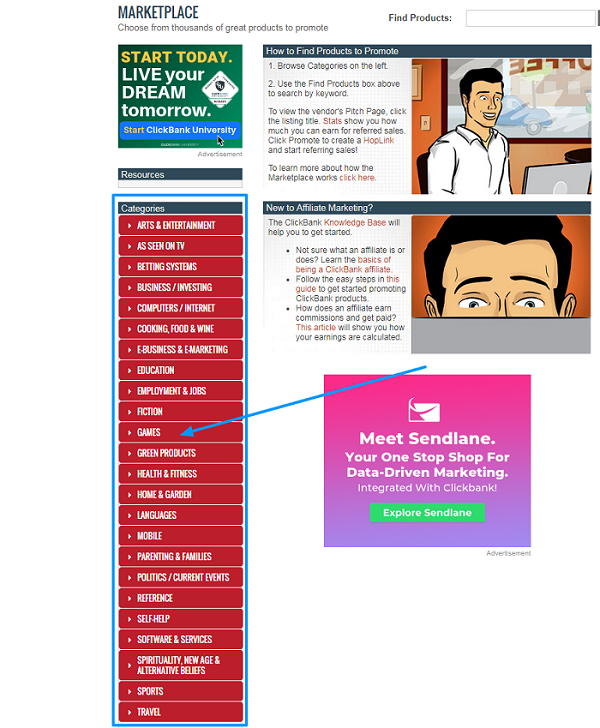
First, click on the affiliate marketplace on the menu and then choose your category on the left:

ClickBank categories

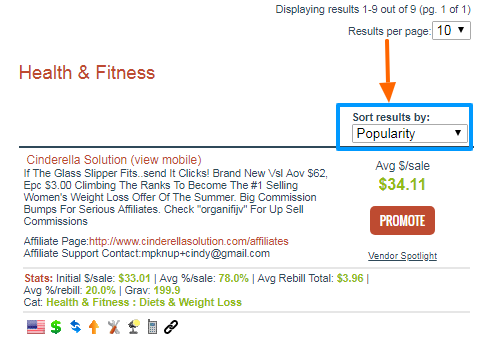
You’ll then see a list of products displayed. You can choose how the results are sorted: popularity, Ave $/Sale, Initial $/Sale, Ave %/Sale, Gravity, and so on.

ClickBank sort results

Results are sorted according to a program’s popularity by default. Zoom into the product that meets your predetermined metrics. Two crucial metrics to consider are gravity and Average $/Sale aka your cut.

Here’s a product with potential:

ClickBank program example

With a high gravity of 137 and a fine commission of $66, this program can be a moneymaker. Now that you’ve found a good product, it’s time to click promote and enjoy the delightful ka-ching cash register sound, right?

Not so fast, my friend.

Dig deeper.

Go to the program’s affiliate page to find out more about the product.

Critical Bench Products

Always be on the lookout for vendors with affiliate promotion tools pages. These are serious vendors who have done the heavy lifting for you to make your work easier.

Typical tools you’ll find include:

  • Banners
  • Product images
  • Videos
  • Pre-sell content
  • Swipes for email marketing campaigns
  • Keywords
  • Press releases
  • Landing pages / sales pages
  • Opt-in rates
  • Customer demographics

Here’s an example:

Afilliate promotional tools

Surely with all these materials on hand, even a slacker like you can make this work. 🙂 Remember, these tools are tried and tested. Use them as they are. Only tweak them if you are double sure the change will make them a better fit for your audience.

Another cool tip is to search for discounts on the affiliate program page so you get a bigger cut.

When you’re done, click promote, fill in your account details, and grab the affiliate links you’ll use to promote the product:

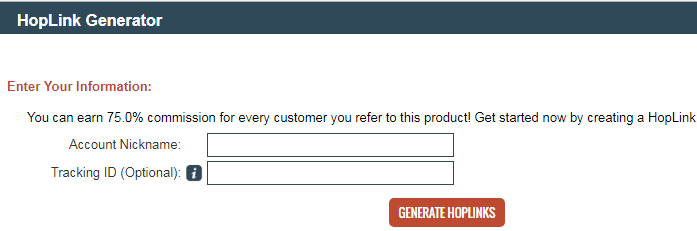
ClickBank Hoplink

That’s how you join a solid program.

Now, want to explode your profits?

How To Make Money On ClickBank: 4 Top Tips to Rake In Big Bucks

I won’t lie to you.

Making money on ClickBank, like anything worthwhile, won’t be smooth sailing, especially at the beginning.

It’ll take creativity, trial and error, a jumbo size coffee urn for that much-needed caffeine fix — and loads of patience.

Here are 4 tips to help get you started:

1. Don’t be obsessed with high gravity and $/Sale

It’s not necessarily the product with the highest gravity or Ave$/Sale you should focus on.

Programs with a very high Av$/Sale have stiffer competition.

And, they usually have lower conversions.

Those in the middle have higher conversions.

Find the right balance.

2. Wrap up your offer in relevant content

Successful affiliate offers hinge on context. You can put the offer on your newsletter, a high-performing blog post, or on a ‘products we recommend’ page.

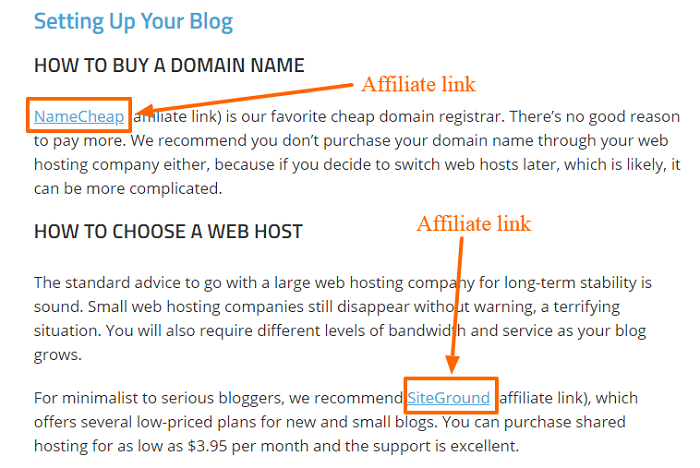
Here’s a little case study of this tactic right here on Smart Blogger. Click on ‘Tools We Recommend’ on the menu and you’ll see this:

Smart Blogger affiliate links

What I love about this is that they don’t just provide a bare shopping list of resources like many sites do. They package their recommendations in the form of a post. This way the endorsements look natural, not forced.

The result? More sales.

You can craft a special piece of content for specific offers.

Think of it like a jigsaw puzzle. Your free content provides a piece that can only be completed by the offer.

3. Get the product/audience fit right

With thousands of flashy products on show, the temptation to promote any top-selling program to your audience is strong.

Resist it.

Two reasons:

  1. If your offers aren’t a good fit for your audience, you won’t make money, period. Eventually, you’ll get discouraged and curse the ClickBank gurus for ‘misleading’ you.
  2. Offers that don’t resonate with your audience will wear them down. They’ll develop ‘offer blindness’. They won’t respond to future offers. Ultimately, they’ll stop trusting you.

Only join programs that add value to your audience.

It’s best for everyone.

Your audience will adore you for proposing great products to them.

You’ll make more money.

4. Create an evergreen YouTube funnel

Most ClickBank affiliate marketing strategies focus on email marketing (sending emails to your list), social media promotion (tweeting or sharing your affiliate links), or SEO (creating top-notch content around your affiliate product and getting it to rank on Google).

But there’s another area most e-commerce gurus ignore: video. Specifically, YouTube.

Smart marketers take advantage of the powers of YouTube, the second largest search engine, to set up a high-converting ClickBank funnel.

Here’s how:

  1. Find the right product to promote
  2. Search for popular content related to the product on YouTube
  3. Dissect the content to see why it’s popular
  4. Produce similar content in your own YouTube channel

Link to the product in your video. Watch the money come in like clockwork.

Need a real-life example? Check out this review of a popular ClickBank product, The Flat Belly Fix.

ClickBank Review Verdict: Boo or Bravo?

Let me ask again.

Can you make money on ClickBank?

Absolutely.

Just be sure to do your homework.

If you thoroughly vet the programs, you’ll cash in.

Many folks like you make $50-$100 a day on ClickBank. That’s a yummy $1500+ passive monthly income made while you catch some Z’s.

You can do it too. Hop over to ClickBank and get started now.

About the Author: According to his cheeky wife, Qhubekani Nyathi aka The Click Guy is an irresistibly handsome guy. He’s an offbeat long-form content writer who helps SMBs grow their income through zingy content that ranks, drives leads, and builds authority. He contributes to prestigious blogs like Search Engine Watch, Crazy Egg, Business 2 Community, Get Response, Clickz, and The Drum.

The post ClickBank: The Brutally Honest, Must-Read Guide for 2020 appeared first on Smart Blogger.


from
https://smartblogger.com/clickbank/

Friday, January 24, 2020

Why You Can’t Find Time To Create [PODCAST]

Finding time to create can be difficult.

Do you find yourself constantly promising yourself that you’ll make time to create and constantly breaking that promise? Do you feel guilty about not making time to create? Maybe you’re bewildered at how to get out of the cycle?

Today, we’re going to snap you out of it and get you creating the content you should be creating!

Where to Subscribe

How You Can Support the Podcast

Leave us a Review

The more reviews we receive on Apple Podcasts and iTunes, the more listeners we’ll get to reach (thanks to Apple’s fancy algorithm).

If you don’t know how, click here for detailed, step-by-step instructions that’ll show you how to leave us a review on Apple Podcasts and iTunes.

Tell Your Friends & Family

Have friends or followers you believe would enjoy the podcast? Here are a couple quick and easy ways to share it with them:

Tweet This Episode:

It's easy to make excuses for why you don't have enough time to create content. In this #podcast episode, @jonmorrow tackles those excuses one by one.Click To Tweet

Share the Episode on Facebook:

The post Why You Can’t Find Time To Create [PODCAST] appeared first on Smart Blogger.


from
https://smartblogger.com/podcast-why-you-cant-find-time-to-create/

Thursday, January 23, 2020

Stuck? Try These 72 Creative Writing Prompts (+ 6 Bonus Tips)

I bet you just asked Google to search for creative writing prompts.

Or was it writing ideas? Story ideas? Or maybe writer’s block?

Boy, are you stuck!

But don’t worry. It doesn’t matter if you’re halfway through writing a book, sweating over social media posts, or journaling about your own life, all writers get stuck for creative ideas sometimes.

So, it’s great to have you here.

This is your go-to source of story starters, writing prompts, and bonus writing tips guaranteed to improve your writing skills, power up your passion, and get your creative juices flowing in 2020.

Here’s what we’ll cover:

We’ll start with a few common questions and answers.

Creative Writing Prompts (Plus Bonus Tips)

What are Writing Prompts?

A writing prompt can be a phrase, an image, or even a physical object that kick starts your imagination and motivates you to write. It provides a spark of an idea as a starting point to stimulate a natural flow of writing.

Writing prompts are ideal for any form of writing, like fiction or nonfiction, journaling, copywriting, blogging, or poetry. They usually contain two parts: an idea or a potential topic to write about, and the instructions on what you should do next.

For example, a creative writing prompt for fiction writers might be:

Your main character has a car accident and starts to hear voices while in the hospital. Write a short story about the conflict between the character and the voices and what really happened at the time of the car accident.

While journal prompts tend to focus on topics of self-awareness, such as:

Write about a turning point in your life. How different would things be now if you had made a different decision at the time?

What is the Purpose of Writing Prompts?

Writing prompts are like a pre-match warm-up. They help to relax your creative muscles, unblock your imagination, and free up your mind to focus on the main game of writing without fear or hesitation.

Instead of wasting time by thinking of a topic to write about, writing prompts get your creative juices flowing straight away, compelling you to put pen to paper.

Writing prompts also help you see things in a new light. They force you to think outside your comfort zone and use your imagination and creativity like never before.

Without them, we can become permanently sidelined by our inner critic. Or worse still, the gripping cramp of writer’s block.

How Do You Use Writing Prompts?

Like all muscle-building exercises, writing prompts are most effective when you make them a daily habit. Over time, with repetition, you’ll find your flow of writing becomes more natural, and your ability to write for longer strengthens.

But don’t feel you have to follow a prompt to the letter. If the prompt suggests you write about romance, but it sparks an idea for a poem, write a poem. Let your imagination guide you through the writing process.

Here are some other hot tips:

  • Don’t overthink it. Just start writing.
  • Don’t edit as you go.
  • If it’s not working for your style of writing, move on to another prompt. Find the prompts that make you want to write.
  • The creative writing prompt is a starting point. The finish is up to you. You don’t have to write a complete story, a poem, or an essay. Feel free to discard your work halfway through and move on to something else.
  • Adopt the Ernest Hemingway approach: Accept that most of what you write is likely to be crap, and you’re going to toss it. This isn’t about producing ready-to-publish work for your latest freelance writing job. It’s about the practice of writing.

How Else Can I Improve My Creative Writing Skills?

Improving your skills takes lots of writing practice. And using creative writing prompts is one of the best ways to do just that. But it’s not the only way. Here are a few other techniques you might want to explore:

Freewriting

This is when you write about anything that pops into your head. Take a blank sheet of paper, set a timer for 30 minutes, and start writing. Write whatever your brain tells you to, and don’t worry if it’s nonsensical.

This exercise is great for pushing through writer’s block and allowing your mind to head off in spontaneous directions.

The Adjectives Game

List 5 things you like or dislike tasting, and then list 5 adjectives for each item. For example, you might like the taste of cake. The 5 adjectives might be: sweet, gooey, yummy, nutty, and scrumptious. Now do the same for your other senses.

This builds your sensory vocabulary and ability to write with flair and color.

Perspectives

Write about a recent incident you were involved in, from the point of view of someone else who was involved. Empathy is hugely important in writing and this exercise forces you to step into the shoes of another person and understand their point of view.

Dialogue

Writing authentic dialogue is notoriously hard to master, so this exercise will help.

Write about 300 words of a conversation between two people without using ‘he said/she said’ tags. Show the difference and relationship between the two speakers only through the words they use. It’s more challenging than it sounds.

Observation

Think of a color. Now go for a walk or a ride on the bus and note down everything you see of that color. When you get home, write up what you remember (take notes as you go to make it easier).

How many different hues of the color did you see? What did the things you saw make you feel? Was there any connection between them?

Brevity

Think of an anecdote you like to recount. Write it up in less than 500 words. Now rewrite the same story in 100 words. Now in 50 words. And finally, in 25 words or less, if you can achieve it.

This exercise shows how filler words, background, and context can sometimes get in the way of a good story. It will help you choose your words carefully.

If you’ve got the time and energy, here are a few more exercises to really help flex those writing muscles.

Now, let’s explore those creative writing prompts we promised you.

Fiction Writing Prompts

  1. “It was the best of times. It was the worst of times.” Use this famous opening line to start your own novel.
  2. Rewrite your resume as a short story, either in the first or third person.
  3. Open the dictionary at any page and select the first word that catches your eye. Write the opening few paragraphs of a thriller using that word at least three times.
  4. Write a synopsis of your version of the movie, Groundhog Day. What would your day look like and why?
  5. Write a short story using these words: Mountainous, parched, field mouse, and Black Forest Gateau.
  6. Sit in a cafĂ© and write a short story about the person or couple at the next table. Take note of their body language and clothing, what they’re eating, or doing. And if you can eavesdrop, let their conversation inspire you too.
  7. Write about a person who is arrested for committing a crime, but they can’t remember anything about the night the crime occurred. What is the crime, why can’t they remember and what happens next?

Fantasy Writing Prompts

  1. If you could come back to life as any person, animal or thing, what or who would you be and how would you live your second life?
  2. The world’s oceans dry up. Who or what survives?
  3. You open the bathroom door and find the room’s disappeared. In its place is another world. Describe what you see and hear, and what you do next?
  4. You’re sitting at a bar talking to a giraffe. What’s the conversation about?
  5. You live in a fantasy world where people communicate without talking. Write about an average day in this sci-fi world.
  6. You are the inventor of a popular video game. One day the main character from your game knocks on your front door. What does he want?
  7. Write about a character who has a superhuman power. The problem is, they don’t want it. Write about the conflict between the character, his or her power and the life they are forced to lead.

Romance Writing Prompts

  1. What is the most romantic season of the year and why?
  2.  Write a story about love at first sight. It doesn’t have to be about young people, or even about people.
  3.  “Last Christmas” was a song by George Michael that inspired a movie by the same name in 2019. Think of your favorite romantic song and write a film synopsis for it.
  4. If you are a woman, write a short love story about the most romantic experience you could imagine, as a man. If you are a man, reverse the exercise.
  5. The song “Summer Nights” from Grease is about the summer romance between two high school students, with their friends begging to hear more. What memory does that evoke for you about the first time you fell in love, and who did you tell?
  6. Next time you visit a grocery store make a note of the first person you see. What are they wearing, what are they buying, are they alone? Write a description of them as the main character for your next romantic novel.
  7. Your protagonist is about to marry the man she has been in love with for years. A week before the wedding she meets a stranger and falls madly and hopelessly in love. What does she do?

Comedy Writing Prompts

  1. You are a bartender on a quiet night, listening to man drown his sorrows as he tells you how his wife has recently left him for a neighbor. A second man enters and sits at the other end of the bar. It’s the neighbor. Describe the comedy of errors that happens next.
  2. What makes you laugh out loud?
  3. What’s the funniest joke you know? Write the backstory to the main character in the joke.
  4. What’s the funniest thing that’s happened to you in real-life? Write it as a stand-up comedy anecdote with lots of observational humor thrown in.
  5. Your shopping bag rips apart, and all the contents tumble out at the feet of the girl or guy who lives in the apartment below you, who you have fancied for some time. What does your shopping reveal about you and why are you so embarrassed?
  6. List posts are one of the most popular forms of blogging. Write a funny list post about all the things you are not going to do in 2020.

Horror Writing Prompts?

  1. Write the opening chapter to a story that begins: “I stared at my beautiful, evil wife and realized the horror had only just begun.
  2.  “Terror made me cruel” is a line from Wuthering Heights by Emily Bronte. Write about a situation where terror might make you cruel.
  3. You’re walking home alone late one night when you realize several cats are stalking you. Then the streetlights go out. What happens next?
  4. There’s a locked door at the top of the house you’re staying in. What’s behind it?
  5. What are you really, really scared of? Put yourself in that situation and describe how it feels.
  6. Write a horror story set in either a bar or a graveyard (or both). Include a blue-veined hand and the phrase “all that spit and sweat.”

Persuasive Copywriting Prompts

  1. Your best friend doesn’t much care for Chinese food. Write down all the reasons why they need to reconsider their opinion and join you tonight at your favorite Chinese restaurant.
  2. Your mother’s always nagging you to clean your room. Write an account of the last time she nagged you, but from her point of view.
  3. Have you ever seen a ghost, or sensed a ghostly presence? Write an account of your experience knowing it will be read by a sceptic.
  4. Talk the Christmas Grinch out of being a Grinch.
  5. A man finds a letter in a bottle while walking on the beach. Where has the bottle come from, how old is it, and what does the letter say? What does it compel the man to do?
  6. Think of a cliché and write an argument against it. Here are a few to start you off:

Time heals all wounds

It’s better to be safe than sorry

Money is the root of all evil

Ignorance is bliss

Poetry Writing Prompts

  1. Open the dictionary at any page and select the first word that catches your eye. Set a timer for 5 minutes and write a list of rhyming words. Now write a poem using as many of those words as you can.
  2. Write a poem about rhythm. It might be about music, or the flow of a river, or the clattering sound of a train. Weave the rhythm you hear in your head into the tempo of your poem.
  3. Write a poem about a feast. Describe how it looks, smells and tastes. Include the different sensations of spices and flavors, the texture and feel of the dishes and how each one made you feel as you ate more and more.
  4.  Write a poem about the “Thrilla in Manila.”

Journal Writing Prompts

  1. Write about your plans for tomorrow and how you hope they’ll turn out.
  2. “It is a far, far better thing that I do, than I have ever done.” This is a famous quote about self-sacrifice from A Tale of Two Cities by Charles Dickens. Write an honest journal entry about how far you would be prepared to go to sacrifice your wealth, happiness, health, or safety for a person or principle.
  3. Write about a single day — either the first or last of your life.
  4. Think about the last time you woke up at 4am, in a cold sweat. What was on your mind and how did you resolve it? Did you feel differently about it in the daylight?
  5. Write a letter in your journal to each of your family members, telling them what your love (and/or hate) about them.
  6. What is your personal manifesto? What are the core principles and values that guide everything you do in life?
  7. Make a list of all the things you’d like to say no to, and then write down the reasons why you don’t — or can’t — say no. Is there a pattern? Is there something you can change?

Blog Writing Prompts

  1. Write about the biggest challenge you have faced and how you overcame it.
  2. Write an open letter to a person or group of people you strongly disagree with and explain why. Use reason not emotion.
  3. Write about the best health or weight loss tips you can share.
  4. Interview your favorite fictional character.
  5. Describe social media to someone who has never heard of it before. Include advice on which platform might be best for them.
  6. Think of the 3 most unhealthy habits you indulge in and write about how you might be able to break those habits.
  7. What are the top 10 style trends you would like to see make a comeback in 2020?

Non-Fiction Writing Prompts

  1. Write about your views on climate change. Are you a believer or a sceptic? Is the world doing enough? What facts do you know?
  2. Write about a time you had to swallow your pride and do something that made you uncomfortable, either morally or physically.
  3. There is no such thing as a truly unselfish deed. Defend this statement.
  4. If you were to write an autobiography, how would it start?

Random Writing Prompts

  1. Write a fantasy story based on the last dream you had.
  2. Write about your favorite place and how it makes you feel. Use all the sensory language you can muster to describe the place.
  3. If you were a dog, what type would you be and who would own you?
  4. If you had the opportunity to turn back time what would you change about the course of your life and why?
  5. What is your favorite thing to eat and what memories does it evoke?
  6. Write a list of your three most prized possessions (inanimate objects, not people or animals). Imagine you are forced to discard one. Which one would it be and explain the reasons for your choice?
  7. Write your own eulogy. What would you like people to know and say about you?
  8. Write 500 words on what financial freedom looks like to you?
  9. Select a book from your bookshelf and open it to any page. Write out the last sentence of the last complete paragraph on that page and continue writing.
  10. Think of your favorite film or book. Now rewrite the ending to something completely different.
  11. If you were to buy a plane ticket today — no expense spared — where would you go and why?

There they are. A compact list of 72 writing prompts. And when you’ve worked your way through these, you might want to move on to the motherlode of creative writing prompts over at Reddit.

Reddit is part social media platform, part community, part media curator, with 520 million monthly visitors subscribing to message boards across 1.2 million sub-categories. Phew!

One of these subcategories is Writing Prompts, with over 13.3 million subscribers who have posted years’ worth of prompts, so you’ll never run out of inspiration again.

6 Bonus Writing Tips to Power Up Your Passion and Sharpen Your Skills

Before we let you go…

If you’re looking for creative writing prompts or story ideas, there’s an excellent chance you’re looking for other ways to hone your skills and improve your craft.

Here are 6 bonus writing tips to help you on your journey:

1. Make Time to Write

If you’re not setting aside time to write, you may as well ignore every other piece of advice in this post. Make your writing time sacred and block it off in your calendar. Turn off your phone. Disconnect the internet, close your door, and write.

This is the single best thing you can do if you want to be a writer.

2. Set Writing Goals

We set goals for everything in our life: losing weight, saving for a dream holiday, growing our business, and so on. So, do the same for your writing. Measure your progress.

Start with, say, 300 or 500 words in a daily session. Once you consistently reach this goal with ease, up the ante and shoot for more challenging targets. 1,000 words a session; 25,000 words a month, and so on. But make sure your goals are not overwhelming.

Goals will help you write faster, with more confidence. Over time you will recognize when you are most productive and can use this to your advantage.

3. Pack Your Writing with a Powerful Punch

Fill your writing with passion from an arsenal of power words. Or supercharge your reader’s imagination with a well-aimed metaphor.

Use these two writing devices to turbocharge your prose and watch the words burst off the page with intention.

4. Harness the Power of Grammar

Grammar reduces confusion and brings clarity and confidence to your writing. It’s a good thing and you need to learn the rules.

But grammar can sometimes get in the way of creativity and turn fluid prose into a turgid swamp of clunky awkwardness.

If starting a sentence with a conjunction feels right, go for it. If you want to brazenly split an infinitive to avoid mangling a sentence, split away.

So, learn the grammar rules, but then learn how to break them. Effectively.

5. Copy Your Writing Heroes — Literally

Pick a writer you’ve always admired, even envied. Now, put pen to paper and rewrite exactly what they wrote by hand. Don’t think too hard about it. Just go with it.

As you write out their words, you’ll absorb their writing style, their pace and rhythm, their grammar, their word choice, and their sentence structure.

This is one of the most effective ways to sharpen your writing skills and inspire your own writing voice.

6. Read Your Way to Writing Stardom

Every great writer is a great reader. There are no exceptions.

Read daily.

Read fiction and biographies, or read books, blogs and articles. But read in an active way. Stay alert to what grabs your attention and how the writer has crafted his words. Then consciously apply the best techniques to your own writing process.

A Final Word on Writing Prompts

The purpose of a writing prompt is to kickstart your creativity and spur you into writing something… anything.

Initially, the process may seem a little intimidating. But that’s OK. Most writers draw a blank when they first start with writing prompts.

Keep pushing through, because something thrilling will start to happen.

The more you practice using the prompts in this post, the more your creative juices will flow, and the more words and ideas will start pouring out of you.

So, let yourself go. Abandon yourself to the power of writing prompts and let the magic happen.

Happy writing!

About the Author: Mel Wicks is a seasoned copywriter and newly minted digital nomad. She helps clients bring the ‘OMG! Where do I sign up?’ oomph to their online marketing; and blogs about the highs and lows of being a nomadic freelance writer.

The post Stuck? Try These 72 Creative Writing Prompts (+ 6 Bonus Tips) appeared first on Smart Blogger.


from
https://smartblogger.com/creative-writing-prompts/