Thursday, February 27, 2020

600+ Power Words That Pack a Punch and Convert like Crazy

Power words are like a “cheat code” for boosting conversion rates. Sprinkle in a few, and you can transform dull, lifeless words into persuasive words that compel readers to take action.

And the best part:

You can use them anywhere.
600+ Power Words That Pack a Punch and Convert like Crazy

In this post, you’ll learn how to use power words like a kung fu master. Specifically:

  • The definition of power words (and why they’re so powerful);
  • The 7 types of power words proven to increase conversions;
  • Examples of how bloggers, writers, and businesses are using power words to boost conversions;
  • 600+ powerful words you can use, bookmark, and reference (again and again).

Let’s jump in.

Clear as mud?

Let’s deconstruct an example from the great Winston Churchill. All the power words are underlined:

We have before us an ordeal of the most grievous kind. We have before us many, many long months of struggle and of suffering. You ask, what is our policy? I can say: It is to wage war, by sea, land and air, with all our might and with all the strength that God can give us; to wage war against a monstrous tyranny, never surpassed in the dark, lamentable catalogue of human crime. That is our policy. You ask, what is our aim? I can answer in one word: It is victory, victory at all costs, victory in spite of all terror, victory, however long and hard the road may be; for without victory, there is no survival.

Inspiring, right?

Well, there was a lot on the line. Under attack from Germany, Britain was fighting for its survival, and somehow, someway, Churchill had to find a way to inspire his countrymen to greatness.

He chose words. Or, to be more accurate, power words.

Each underlined word makes the audience feel something.

In this case, Churchill intermixes words that cause fear, such as “struggle,” “tyranny,” and “terror,” with words that cause hope, such as “strength,” “God,” and “victory.” The last, in particular, is repeated over and over, practically drilling the emotion into the minds of the audience.

It’s no accident.

Power Words = Emotional Words Packed with Persuasion


Smart speakers, as well as their speechwriters, sprinkle their speeches with carefully-chosen power words drenched in sensory details, drawing the audience from one emotion to another as skillfully as any novelist or screenwriter.

And it goes beyond speakers and storytellers.

Email marketing messages, resumes, copywriting, blog posts, infographics, step-by-step tutorials, sales copy, inspirational quotes, content marketing, and proposals are all designed to influence the reader in some way. You want to pass along information, yes, but you also want the reader to feel a certain way about that information.

Maybe you want to impress them, get them excited, make them cautious, get them angry, encourage them to keep going, or any number of emotions. The better a job you do at making them feel, the more influential you are, and the better your chances of getting what you want.

So…

Looking for a quick way to give your writing more punch?

Maybe add a little personality or pizzazz — that extra little “oomph” that makes your reader pay attention?

Want to bring your ideas to life, to make them take up residence in the mind of the reader, lurking in the background, tugging, pulling, and cajoling their emotions until they think and feel exactly as you want?

Then you need to infuse your content with power words.

We’ve organized our power words into seven different types, which all accomplish the same goal: Each elicits emotion in your reader.

Let’s go over each type and see why these words work.

1. Fear Power Words


Let’s do a little experiment.

Just for a moment, stop reading this post, turn on the television, and go to a major news channel. Watch it for five minutes, listening for the words below.

Chances are, you’ll hear dozens of them. Here’s why:

Fear is without a doubt the most powerful emotion for grabbing and keeping an audience’s attention. To make sure you don’t change the channel, news networks load up with fear words, making you worry you might miss something important.

Granted, you can overdo it, but in my opinion, most writers don’t use these types of words nearly enough. They really do connect with people.

How to Crank Up Emotion with Fear Words

Here’s an example of a blog post headline here at Smart Blogger that utilizes three different fear words:
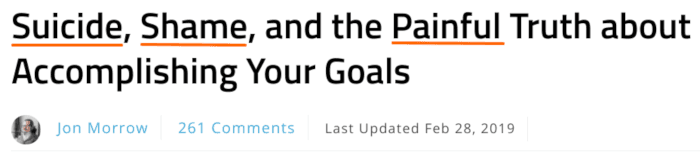
Fear Power Words in Headlines

Open it and you’re greeted by this fear-packed introduction:

I was in agony.

Waves of pain unimaginable shot down my spine, causing every muscle in my body to contract as if I’d been shocked with 20,000 volts of electricity. My back arched up at an unnatural angle. My arms and legs began to shake.

One moment, I was on a webinar talking to a few hundred people about traffic, walking them through exactly how to start a blog and make it popular. The next, everything went dark. I was still conscious, but just barely.

Pretty effective, right?

If you’d like to sprinkle fear power words into your writing, here are a bunch to get you started:

Agony Lunatic
Apocalypse Lurking
Armageddon Massacre
Assault Meltdown
Backlash Menacing
Beating Mired
Beware Mistake
Blinded Murder
Blood Nightmare
Bloodbath Painful
Bloodcurdling Pale
Bloody Panic
Blunder Peril
Bomb Piranha
Buffoon Pitfall
Bumbling Plague
Cadaver Played
Catastrophe Plummet
Caution Plunge
Collapse Poison
Corpse Poor
Crazy Prison
Cripple Pummel
Crisis Pus
Danger Reckoning
Dark Refugee
Deadly Revenge
Death Risky
Deceiving Scary
Destroy Scream
Devastating Searing
Disastrous Shame
Doom Shatter
Drowning Shellacking
Dumb Shocked
Embarrass Silly
Fail Slaughter
Feeble Slave
Fired Strangle
Fool Stupid
Fooled Suicide
Frantic Tailspin
Frightening Tank
Gambling Targeted
Gullible Teetering
Hack Terror
Hazardous Terrorist
Hoax Torture
Holocaust Toxic
Horrific Tragedy
Hurricane Trap
Injure Vaporize
Insidious Victim
Invasion Volatile
IRS Vulnerable
Jail Warning
Jeopardy Worry
Lawsuit Wounded
Looming Cringeworthy
Last chance Fugacious

2. Encouragement Power Words


Let’s face it.

When they’re reading, most people aren’t exactly bouncing off the walls with energy and enthusiasm. They’re probably bored, maybe a little depressed, and almost definitely tired.

And they’re looking for something, anything, that’ll wake them up and make them feel better.

The good news?

Your writing can do that for them.

How to Crank Up Emotion with Encouragement Words

Here’s an example email from Mirasee:

Encouragement Power Words in Emails

With two encouraging words — life-changing and magic — in one subject, it’s an email that stands out in most inboxes.

Want to give your readers a pep talk and get them charged up again? Want to encourage them?

Use these persuasive words:

Amazing Jubilant
Ascend Legend
Astonishing Life-changing
Astounding Magic
Audacious Marvelous
Awe-inspiring Master
Awesome Mind-blowing
Backbone Miracle
Badass Miraculous
Beat Noble
Belief Perfect
Blissful Persuade
Bravery Phenomenal
Breathtaking Pluck
Brilliant Power-up
Celebrate Praise
Cheer Prevail
Colossal Remarkable
Command Revel
Conquer Rule
Courage Score
Daring Seize
Defeat Sensational
Defiance Spectacular
Delight Spine
Devoted Spirit
Dignity Splendid
Dominate Spunk
Effortless Staggering
Empower Strengthen
Epic Striking
Excellent Strong
Excited Stunning
Extraordinary Stunt
Eye-opening Supreme
Fabulous Surprising
Faith Terrific
Fantastic Thrive
Fearless Thwart
Ferocious Titan
Fierce Tough
Force Triumph
Fulfill Tremendous
Glorious Unbeatable
Glory Unbelievable
Graceful Unforgettable
Grateful Unique
Grit Unleash
Guts Uplifting
Happy Valiant
Heart Valor
Hero Vanquish
Honor Victory
Hope Win
Incredible Wonderful
Jaw-dropping Wondrous
Kudos Brighten
Lovable Radiant
Flawless Classy
Affable Stupendous
Virtuoso Cheery
Openhearted Jovial
Beauteous Logophile

3. Lust Power Words


Like it or not, lust is one of the core human emotions.

Just look at the men’s and women’s magazines in the checkout aisle, and you’ll see what I mean. Nearly every headline on the cover is either blatantly or indirectly about sex.

And it works, not just for men’s and women’s magazines, but for anything.

As a writer, you can use words that inspire lust to make almost anything intriguing.

How to Crank Up Emotion with Lust Words

See if you can spot the lust words in this headline from Cosmopolitan:

Lust Power Words in Headlines

Okay, the orange underlines probably give it away, but my hunch is you didn’t need them.

Power words like captivating and love jump off the page. And if you use them properly, they can stir all sorts of emotions in your readers’ heads.

Here’s a lascivious list of descriptive words to get you started:

Allure Naughty
Arouse Nude
Bare Obscene
Begging Orgasmic
Beguiling Passionate
Brazen Pining
Captivating Pleasure
Charm Provocative
Cheeky Racy
Climax Raunchy
Crave Risque
Delight Rowdy
Delirious Salacious
Depraved Satisfy
Desire Saucy
Dirty Scandalous
Divine Seduce
Ecstasy Seductive
Embrace Sensual
Enchant Sex
Enthralling Shameless
Entice Sinful
Entrance Sleazy
Excite Sleeping
Explicit Spank
Exposed Spellbinding
Fascinate Spicy
Forbidden Steamy
Frisky Stimulating
Goosebumps Strip
Hanker Sweaty
Heavenly Tantalizing
Hottest Taste
Hypnotic Tawdry
Impure Tease
Indecent Tempting
Intense Thrilling
Intoxicating Tickle
Itching Tight
Juicy Tingle
Kinky Turn on
Kiss Unabashed
Lascivious Uncensored
Lewd Untamed
Lick Untouched
Lonely Urge
Longing Voluptuous
Love Vulgar
Lure Wanton
Luscious Wet
Lush Whip
Lust Wild
Mischievous X-rated
Mouth-watering Yearning
Naked Yummy
Sneak peek

4. Anger Power Words


As writers, sometimes our job is to anger people.

Not for the fun of it, mind you, but because someone is doing something wrong, and the community needs to take action to correct it.

The problem is, with wrongdoing, most people are pretty apathetic — they’ll wait until the situation becomes entirely intolerable to do anything, and by then, it’s often too late.

So, we have to fan the flames.

How to Crank Up Emotion with Anger Words

The authors of this Forbes headline don’t pull any punches:

Anger Power Words in Headlines

I didn’t realize some people get angry over business jargon, but apparently it’s a thing. And this headline, undoubtedly, had such people frothing at the mouth.

If you want to connect with people’s anger and slowly but surely work them into a frenzy, use the power words below.

Just be careful who you target. Lawyers can eat you alive if you pick on the wrong person. 🙂

Abhorrent Money-grubbing
Abuse Nasty
Annoying Nazi
Arrogant No good
Ass kicking Obnoxious
Backstabbing Oppressive
Barbaric Pain in the ass
Bash Payback
Beat down Perverse
Big mouth Pesky
Blatant Pest
Brutal Phony
Bullsh*t Pissed off
Bully Pollute
Cheat Pompous
Clobber Pound
Clown Preposterous
Cocky Pretentious
Corrupt Punch
Coward Punish
Crooked Rampant
Crush Ravage
Curse Repelling
Debase Repugnant
Defile Revile
Delinquent Revolting
Demolish Rotten
Desecrate Rude
Disgusting Ruined
Dishonest Ruthless
Distorted Savage
Evil Scam
Exploit Scold
Force-fed Sick and tired
Foul Sink
Freaking out Slam
Full of sh*t Slander
Greedy Slap
Gross Slay
Harass Smash
Hate Smear
High and mighty Smug
Horrid Sniveling
Infuriating Snob
Jackass Snooty
Kick Snotty
Kill Spoil
Knock Stuck up
Knock out Suck
Know it all Terrorize
Lies Trash
Livid Trounce
Loathsome Tyranny
Loser Underhanded
Lying Up to here
Maul Useless
Misleading Violate
Lollygag Quixotic

5. Greed Power Words


The legendary copywriter Gary Halbert once said, “If you want people to buy something, stomp on their greed glands until they bleed.” Graphic, yes, but also true.

Skim through good sales copy, and you’ll find a lot of these power words. Many of them are so overused they’ve become clichĂ©, but that doesn’t stop them from working.

The truth is, nearly every human being on the planet is interested in either saving or making money.

How to Crank Up Emotion with Greed Words

Its explicit and implicit use of greed words makes this popular book from Dave Ramsey a great example:
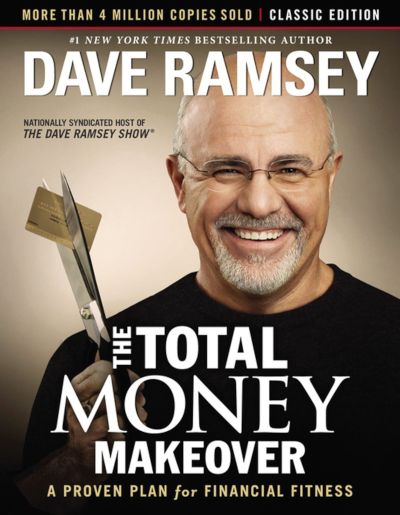
Greed Power Words in Book Titles

“Money” is hard to miss — it’s probably the ultimate greed word and it’s sitting there in capital letters.

But a title like “Total Money Makeover” also implies another greed word (even though it doesn’t directly state it): money-saving.

(It also gets bonus points for using the safety power word “proven”, which we’ll discuss in a moment.)

If you want to stomp on your readers’ greed glands, use these power words:

Bank Jackpot
Bargain Lowest price
Best Luxurious
Billion Marked down
Bonanza Massive
Booked solid Money
Cash Money-draining
Cheap Money-saving
Costly Nest egg
Discount Pay zero
Dollar Prize
Double Profit
Explode Quadruple
Extra Reduced
Feast Rich
Fortune Savings
Free Six-figure
Freebie Skyrocket
Frenzy Soaring
Frugal Surge
Gift Treasure
Golden Triple
Greatest Waste
High-paying Wealth
Inexpensive Whopping

6. Safety Power Words


Greed isn’t the only emotion you want buyers to feel. You also want to make them feel safe.

They need to trust both you and your product or service. They need to have confidence you’ll deliver, and they need to believe they’ll get results.

Of course, building that kind of trust starts with having a quality brand and reputation, but the words you use to describe yourself and your product or service also matter.

How to Crank Up Emotion with Safety Words

On the landing page for one of our Smart Blogger courses, we use power words to make sure our customers feel safe:
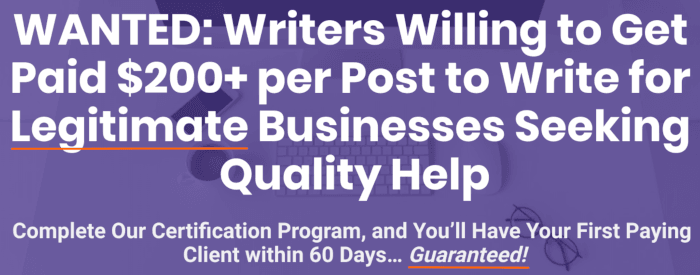
Safety Power Words on Landing Pages

In addition to “legitimate” and “guaranteed” in the screenshot above, our landing page is sprinkled with numerous safety words:

  • Money-back
  • Results
  • Refund
  • Proven
  • Risk-free

They work for us, and they can work for you.

Help your customers feel safe by using as many of these power words as possible:

Above and beyond Privacy
Anonymous Professional
Authentic Protected
Automatic Proven
Backed Recession-proof
Bankable Refund
Best-selling Reliable
Cancel anytime Research
Certified Results
Clockwork Risk-free
Endorsed Rock-solid
Foolproof Science-backed
Guaranteed Scientific
Ironclad Secure
Legitimate Sure-fire
Lifetime Survive
Money-back Tested
No obligation That never fails
No questions asked Thorough
No risk Trustworthy
No strings attached Try before you buy
No-fail Unconditional
Official Verify
Permanent World-class
Guilt-free

7. Forbidden Power Words


Remember when you were a kid, and someone told you NOT to do something? From that point on, you could think about little else, right?

The truth is, we’re all fascinated by the mysterious and forbidden. It’s like it’s programmed into our very nature.

So why not tap into that programming?

How to Crank Up Emotion with Forbidden Words

This Ahrefs article tempts you with its headline:

Forbidden Power Words in Headlines

What’s the “secret”? Only one way to find out.

Whenever you want to create curiosity, sprinkle these power words throughout your writing, and readers won’t be able to help being intrigued:

Ancient Lost
Backdoor Never seen before
Banned Off the record
Behind the scenes Off-limits
Black Market Outlawed
Blacklisted Private
Bootleg Restricted
Censored Sealed
Classified Secret
Cloak and dagger Smuggled
Concealed Strange
Confessions Tried to hide
Confidential Unauthorized
Controversial Uncensored
Covert Under wraps
Cover-up Undercover
Exotic Underground
Forbidden Under-the-table
Forgotten Undisclosed
From the vault Unexpected
Hidden Unlock
Hush-hush Unreachable
Illegal Unspoken
Insider Unveiled
Little-known Withheld
Now that we’ve looked at the different types of power words (and gone over a few quick examples), let’s go over all the different places you can use them:

1. Using Power Words in Headlines


Any blogger who’s been in the game for a while knows the headline is the most important part of writing your blog post.

Its purpose, after all, is to entice the reader to read the rest of your content. If your headline fails to get attention, potential readers will ignore it when it shows up in their tweets and social media feeds.

And just one or two power words in your headline is usually enough to make it stand out.

Just look at this headline from BuzzFeed:

Put Power Words in Your Headline

The word “Unveiled” makes it feel like a secret is being exposed, and the word “Breathtaking” makes you curious to see what the photo looks like.

Here’s another example from BoredPanda:

Put Power Words in Your Headline - BoredPanda

People generally love anything adorable, so this headline will easily catch attention. (The fact that it refers to snakes will only make people more curious.)

The headline then drives it home by using the powerful verb “Conquer.”

Here’s one from BrightSide:

Power Words in Your Headlines - BrightSide

While one or two power words are often enough, this headline proves you can use more when it fits.

This headline has four powerful words, but they feel natural in the headline, which keeps it from feeling like over-the-top clickbait.

Last one:

Power Words in Headline Example - Money

This headline from our How to Make Money Writing: 5 Ways to Get Paid to Write in 2020 post incorporates two greed words: “money” and “get paid.”

It’s one of our most-popular posts, and its headline’s use of power words is a big reason why.

2. Using Power Words in Subheads


Too many writers overlook the value of subheads, which is a mistake. Once people click on your headline, most will scan the post first to see if it looks worthy of their attention.

Adding some power words to your subheads is a good way to make your post look like an interesting read.

For example, here are three subheads from our post on E-book mistakes:
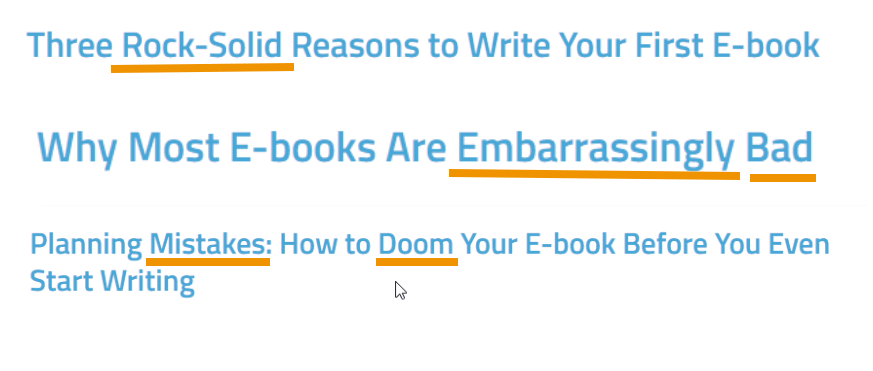
Use Power Words in Subheads

See how the power words in these subheads grab your attention and make you want to read the text that follows?

Adding one or two power words to your subheads will compel readers to stick around longer, which will increase your dwell time — a big deal in Google’s eyes.

3. Using Power Words in Email Subject Lines


Having an email list is of little use if only a handful of readers bother to open your emails.

And these days, most people’s inboxes are flooded, so they’re selective in which emails they open.

You can stand out in their inbox and raise your open rates by including power words in your subject lines.

Just look at this one from Ramit Sethi:

Use Power Words in Email Subject Lines - Ramit Sethi

If this subject line would’ve read “The rules of learning,” do you think it would be as appealing? The word “unspoken” is what makes it interesting.

Here’s another one from Cal Fussman:

Use Power Words in Email Subject Lines - Cal Fussman

Both “Triumph” and “Tragedy” are powerful words full of emotion.

And finally, here’s a good example from AppSumo:

Use Power Words in Email Subject Lines - Appsumo

The power phrase “Unleash the power” makes you feel this email is hiding something incredibly powerful inside.

See how that works?

When you send out emails to your list, try to add a power word to your subject line so it stands out in readers’ inboxes.

4. Using Power Words in Opt-In Boxes


As a blogger, one of your main goals is to grow a large and engaged readership, and the best way to do it is by converting readers into subscribers.

That means — unless you’re using a blogging platform like Medium which doesn’t allow them — you should have opt-in forms scattered across your website.

You can place them on your homepage, at the end of your posts, in your sidebar, in a popup, or anywhere else.

But no matter where you place them, your opt-in boxes must catch people’s eye and make them want to share their email address with you. Because they won’t give it away to just anyone.

(Remember, their inboxes are already flooded, so they’re not necessarily eager to get even more emails.)

Fortunately, you can use power words to make your offer more enticing.

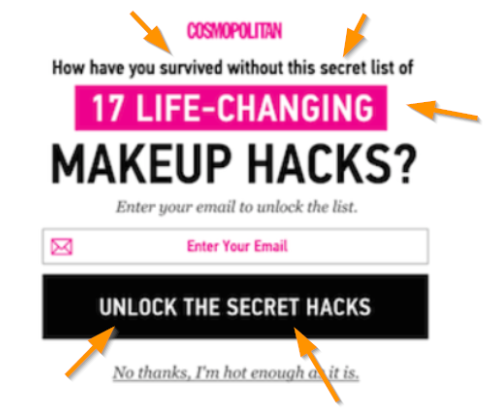
As an example, here’s an old popup from Cosmopolitan:
Use Power Words in Opt-In Boxes - Cosmopolitan

This popup had power words everywhere, but it avoided feeling like overkill. I bet it converted like crazy.

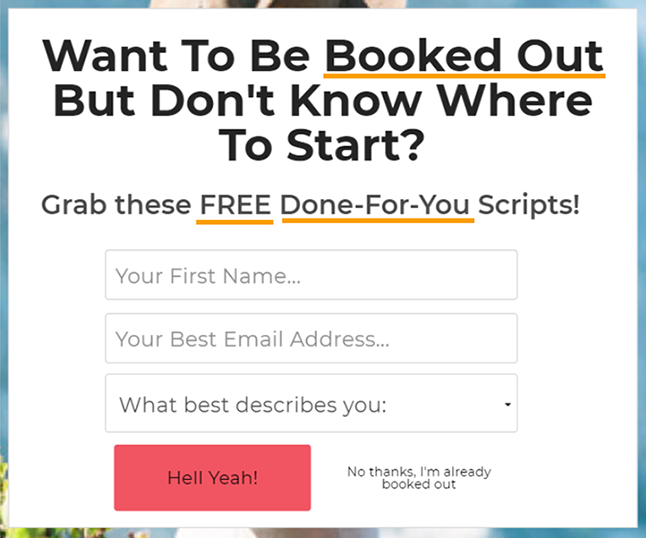
Here’s a slightly more subtle example from Betty Means Business:
Use Power Words in Opt-In Boxes - Betty Means Business

It’s understated, but still quite effective.

Again, you don’t have to overdo it with the power words on these. A little can go a long way.

Here’s one final example from Renegade Planner:

Use Power Words in Pop-Up - Renegade Planner

In short:

If you’re not using power words in your opt-in boxes, you’re missing out.

Big time.

5. Using Power Words on Your Homepage


Your homepage is the face of your website and it’s usually one of the most visited pages. Many people who visit your website will see this page first, so you want it to make a good first impression.

Some people use their homepage to promote their email list, others use it to promote one of their products, and others use it as a red carpet — welcoming new visitors and explaining what their site is all about.

In any case, your homepage is a good spot to add a few power words, as it can determine whether people stay (and take the action you want them to take) or leave (never to return).

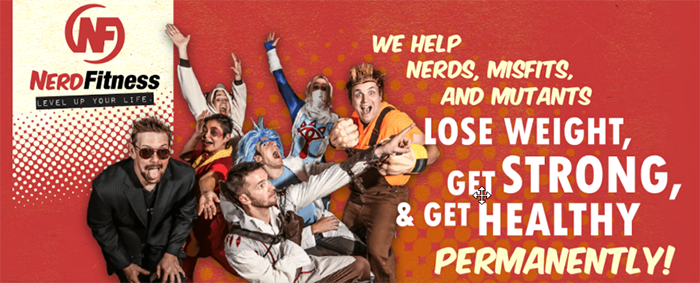
Look at this value proposition on the homepage for Nerd Fitness:
Use Power Words on Your Homepage - Nerd Fitness

“Nerds,” “Misfits,” and “Mutants” are unusual power words that work well for the audience Nerd Fitness is targeting. These words immediately separate it from all the other fitness blogs out there.

But they push it even further with “Strong,” “Healthy,” and “Permanently.”

Here’s another value proposition from MainStreetHost’s homepage:

Use Power Words on Your Homepage - MainStreetHost

It’s quite minimal, isn’t it? They just wrote down three power words and follow it up with a service they provide.

Of course, you don’t have to limit your use of power words to the top of your homepage.

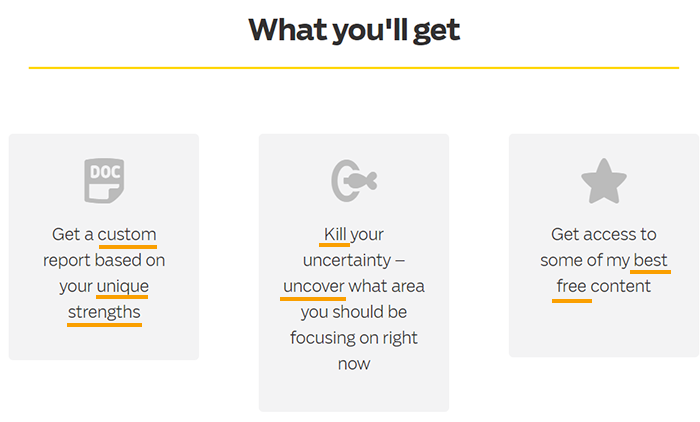
You can use it in other parts of the homepage too, as Ramit Sethi does here in his list of what you’ll get when you sign up for his email list:
Use Power Words on Your Homepage - Ramit Sethi

Go look at your homepage now and see if you can find any areas you can spruce up with some power words.

6. Using Power Words in Business Names/Blog Names


Having a forgettable name is poison to your website’s growth. So when you start a blog, you want to make sure you have a name people can easily recall.

If you haven’t chosen your blog name yet (or if you’re thinking about rebranding), you should use a power word to give it some punch. It’ll make you stand out from all the boring, forgettable brands out there.

Just take a look at the collection of blog names below and see how well they’ve incorporated power words:
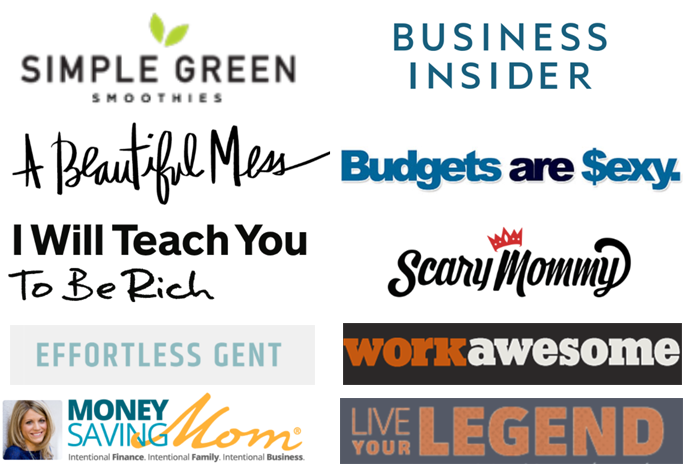
Use Power Words in Business and Blog Names

7. Using Power Words in Product Names


Just like you can use power words to spruce up your blog name, you can also use them to make your product names pack more of a punch.

It can make the difference between your potential customers thinking, “Ooh, this product sounds cool!” and them thinking, “Meh.”

Just check out this subscription product from Nerd Fitness:

Use Power Words in Product Names - Nerd Fitness

It has such a powerful name that you’d almost want to sign up without learning anything else about it. Who wouldn’t want to be part of a community of rising heroes?

Here’s another good example from Pat Flynn:

Use Power Words in Product Names - Pat Flynn Podcast

It’s a powerful name for his podcasting course that instantly informs you of the benefit.

So if you’re about to launch a product (or if you’ve launched a product with a tepid name), consider giving it a power word to make it pack a punch.

8. Using Power Words on Sales Pages


You can also use power words to spruce up your sales pages and make them more effective at selling your e-commerce products or services.

They will grab people’s attention when they arrive on the page, they will keep their attention as they scroll down, and they’ll help seduce readers before they reach your “buy” button.

Just look at this headline on Ramit Sethi’s sales page for his product 50 Proven Email Scripts (which also has a power word in its name):
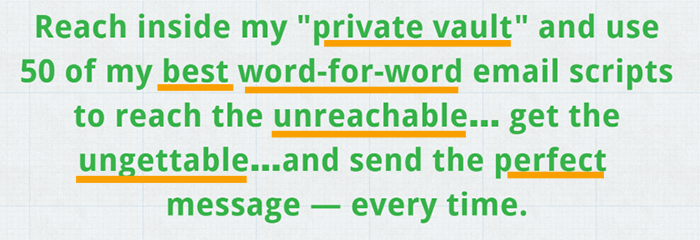
Use Power Word on Sales Pages - Ramit Sethi

And as you scroll down, you see he keeps using power words throughout his sales page.

His headline is followed by emotion-packed subheads:
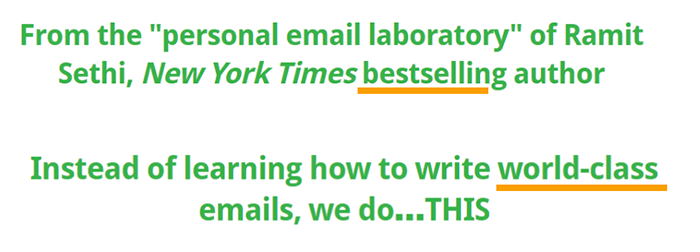
Use Power Word on Sales Page Subheads - Ramit Sethi

And he even uses power words in his guarantee:
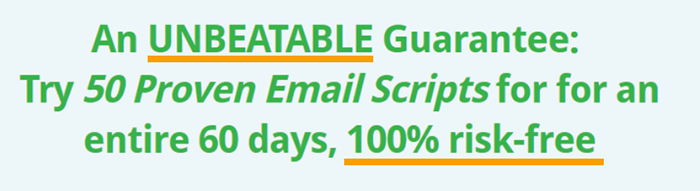
Use Power Word on Sales Page Guarantees - Ramit Sethi

9. Using Power Words in Testimonials


Power words are also tremendously effective in testimonials.

Of course, I’m not suggesting you change people’s testimonials to include power words. But you can certainly select the ones that already use them to great effect.

Just look at this example from Betty Means Business:

Use Power Word in Testimonials - Betty Means Business

Or look at this one from Farideh’s blog:
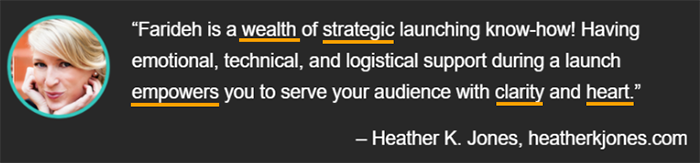
Use Power Word in Testimonials - Farideh

And here’s another example from Renegade Planner:
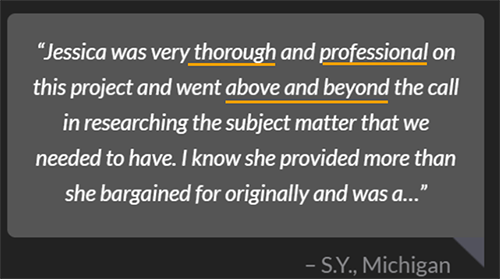
Use Power Word in Testimonials - Renegade Planner

All these testimonials will lend extra credibility and excitement due to their power words and phrases.

10. Using Power Words in Bullet Lists


Many sales pages include a list of benefits of the product they’re selling. Many opt-in forms include a huge list of reasons you should sign up to their email list. And many case studies use bullet lists to quickly summarize information.

You can use power words in these lists to inspire more excitement in your reader as they read through them.

Here’s one example from Ramit Sethi’s sales page for his How to Talk to Anyone course:
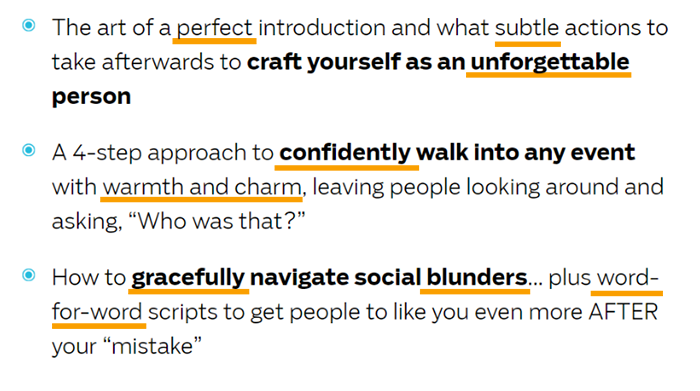
Use Power Words in Bullet Lists - Ramit Sethi

And here’s another example from an opt-in form on Restart Your Style:
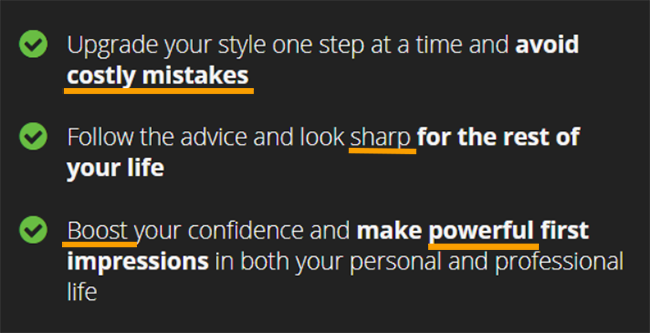
Use Power Words in Bullet Lists - Restart Your Style

Without these power words, these lists wouldn’t convince nearly as many readers to buy or subscribe.

11. Using Power Words in Button Copy and CTA (Call to Action)


Yep, you can use power words in your button copy too — even if you only have a few words you can fit in there.

One of the most common power words used in buttons is “Free” (as in the example below):

Use Power Words in Button Copy

But you can be more creative with buttons than you might think.

Takes this button from the sales page for the book The Renegade Diet:

Use Power Words in Button Copy - The Renegade Diet

“Immediate,” “Money Back,” and “Guarantee” are all incredibly powerful words, and the author manages to squeeze them all into one button.

Here’s an example from Tim Ferris:

Use Power Words in Button Copy - Tim Ferris

He could’ve used “Send Me the List” as most people would do, but “Unlock” makes it sound a lot more intriguing — like you’re getting access to something that’s been kept hidden away.

Now take a look at the buttons on your site.

Do you see any opportunities to spruce them up with a power word?

12. Using Power Words in Author Bios


Your author bio is another extremely important part of your marketing.

When you guest post for another blog (or write a paid article as a freelancer), your author bio has the difficult job of making readers want to know more about you so they click through to your site.

That means your author bio needs to spark attention and interest. And you usually only get three sentences, so you need to carefully consider the words you use.

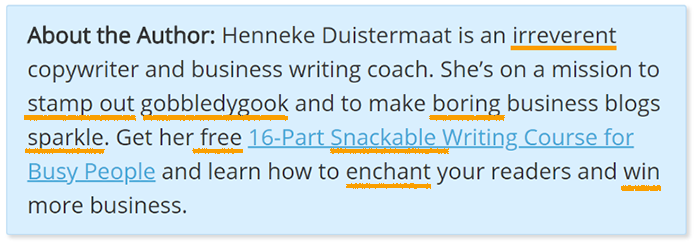
As an example, here’s the author bio from Henneke Duistermaat in her post on overcoming writer’s block:
Using Power Words in Author Bios - Henneke Duistermaat

Henneke’s author bio is full of power words. It shows her uniqueness and makes her stand out from other copywriters.

You can tell she has carefully picked each perfect word for maximum impact.

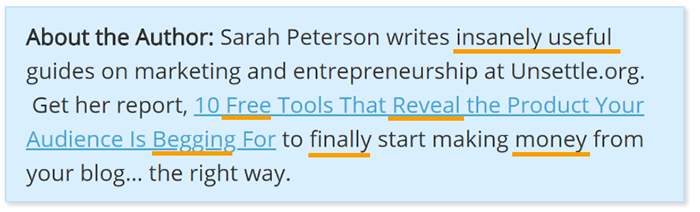
Here’s another example from Sarah Peterson’s post on blog ads:
Using Power Words in Author Bios - Sarah Peterson

She opens strong immediately by mentioning her guides are insanely useful. And just the name of her report alone is full of power words: “Free,” “Reveal,” and “Begging.”

Makes you want to get your hands on that report, doesn’t it?

13. Using Power Words on YouTube Videos


If you’re publishing videos on YouTube and you want to get more views, you should use power words in your titles.

All the biggest YouTube channels do this.

They understand most of their views will come from their subscribers finding them in their feeds, and from people finding them in the sidebar of other videos.

In both cases, you’re competing with many other videos for their attention. If you want your video to stand out and be the one they choose to watch, your title has to be captivating.

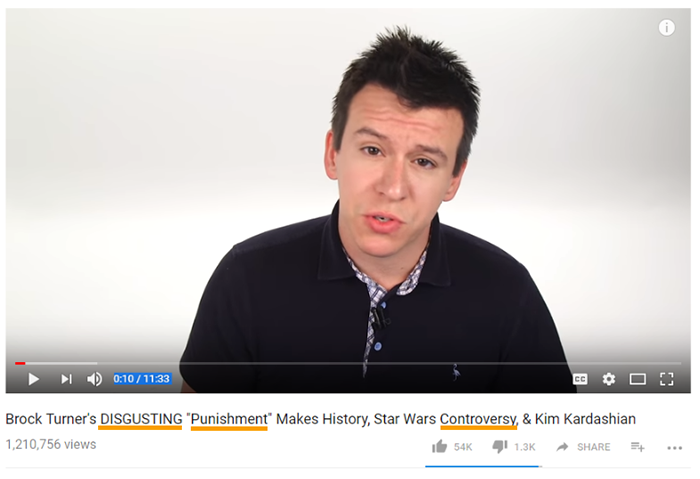
See how Philip DeFranco does it below:
Use Power Words on YouTube Videos - Philip DeFranco

“Disgusting,” “Punishment,” and “Controversy” are all attention-grabbing words (and that’s besides the attention-grabbing names of Brock Turner, Star Wars, and Kim Kardashian).

Note also how he has capitalized “Disgusting.” It’s another smart trick many YouTube channels use to stand out more in YouTube’s lists of video suggestions.

Style vlogger Aaron Marino often does it as well:

Use Power Words on YouTube Videos - Aaron Marino

By capitalizing the power words “Don’ts” and “Stupid,” his title catches a lot more attention (as you can see for yourself by the millions of views it’s received).

14. Using Power Words in Book Titles


If you’re interested in writing your own book, adding power words to your titles will help it sell better.

With all the competition in the book market these days, you need a title that grabs people’s attention and makes them want to peek inside.

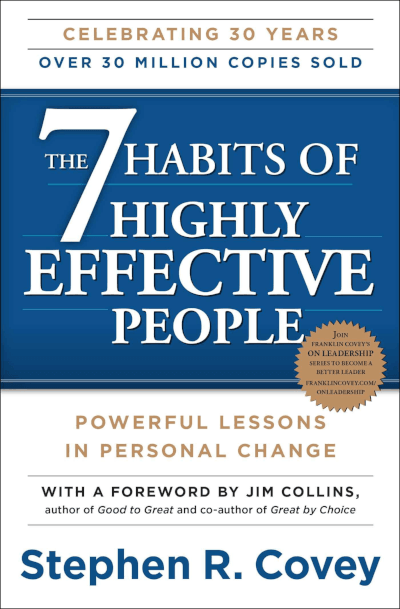
Here are a few quick grabs from Amazon’s list of bestsellers in the self-help niche:
Power Words Book Title - Stephen Covey

I’m sure you’ve seen this title before.

You might say Stephen Covey’s use of power words in his title has been highly effective. (See what I did there?)

Here’s another:
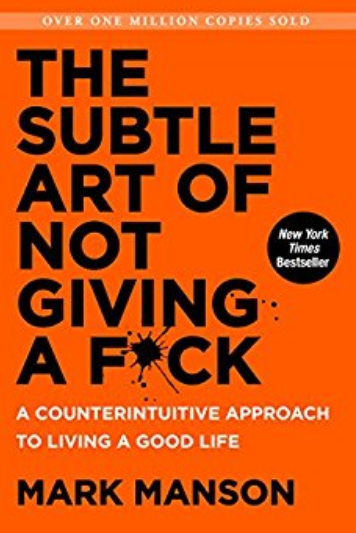
Use Power Words in Book Titles - Mark Manson

Mark Manson’s bestselling title is packed with power.

The power word “Subtle” juxtaposes well with the F-bomb in the title, and his use of “Counterintuitive” will spark some interest as well.

One more:
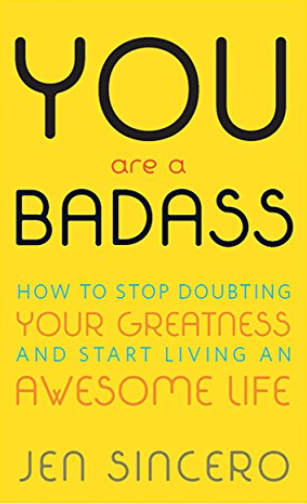
Use Power Words in Book Titles - Jen Sincero

Lastly, Jen Sincero’s encouraging book title makes you want to flip it open and read it in one go.

The use of “Badass” alone will make it stand out in the self-development section, but her use of “Greatness” and “Awesome” in the subtitle truly seals the deal.

Go Ahead and Tell Me. What Powerful Words Did I Miss?

They’re known by many names…

Emotion words. Good words. Strong words. Powerful words, creative words, fancy words, sensory words, trigger words, smart words, feeling words, descriptive words, impactful words, interesting words, positive words, unique words, and even — yes, seriously — awesome words.

But whatever you call them; smart, attractive people such as yourself have mastered the strategic use of power words and use them every day to pack their writing with emotion so they can increase conversions.

Yes, this is an enormous list of words, but with so many power words available, you’d need a thesaurus or Word of the Day dictionary to catch every single word on the first pass. (Plus, new words seem to be added to the English language every day.)

What are some other good words that seem to have that extra little spark of emotion inside them?

Leave your answer in the comments, and as time goes by, I’ll come back periodically and update the power words list. Eventually, I hope to have over 1,000 words here, separated and organized by category, making this the definitive “cheat sheet” of favorite power words on the web.

Thanks in advance for commenting and sharing the post with your friends!

About the Author: Jon Morrow has asked repeatedly to be called “His Royal Awesomeness” but no one listens to him. So, he settles for CEO of Smart Blogger. Poor man. 🙂

The post 600+ Power Words That Pack a Punch and Convert like Crazy appeared first on Smart Blogger.


from
https://smartblogger.com/power-words/

Friday, February 21, 2020

Amy Porterfield: Taking Charge and Being the Boss [PODCAST]

Sometimes the scariest part of starting a business is being the one who makes the decisions.

That fear can keep you from ever starting a business, or it can make you take on a partner when you don’t really need one. Amy Porterfield worked with partners for years until she realized those partnerships were preventing her from spreading her message the way she wanted to.

Get ready for a very vulnerable interview about learning how to take charge and be the boss!

Where to Subscribe

How You Can Support the Podcast

Leave us a Review

The more reviews we receive on Apple Podcasts and iTunes, the more listeners we’ll get to reach (thanks to Apple’s fancy algorithm).

If you don’t know how, click here for detailed, step-by-step instructions that’ll show you how to leave us a review on Apple Podcasts and iTunes.

Tell Your Friends & Family

Have friends or followers you believe would enjoy the podcast? Here are a couple quick and easy ways to share it with them:

Tweet This Episode:

Sometimes the scariest part of starting a business is being the one who makes the decisions. In this episode of the 'Break Through the Noise' podcast, Jon Morrow talks to the amazing Amy Porterfield, who knows a thing or two about it.Click To Tweet

Share the Episode on Facebook:

The post Amy Porterfield: Taking Charge and Being the Boss [PODCAST] appeared first on Smart Blogger.


from
https://smartblogger.com/podcast-amy-porterfield-taking-charge-and-being-the-boss/

Thursday, February 20, 2020

8 Best Grammar Checkers (2020): Grammarly, Ginger, & More

Looking for the best grammar checker in 2020?

If not, you should be.

After all the work you put into your writing, one error — one simple, stupid error — can undermine it all.

That’s why smart writers, marketers, and students use grammar checkers to keep their writing as professional, SEO-friendly, and error-free as possible.

But which grammar checker is right for you? That’s what we’re going to help you figure out.

Let’s jump in.

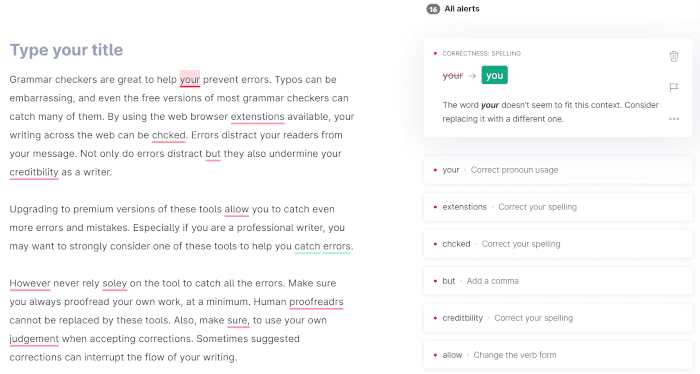
1. Grammarly

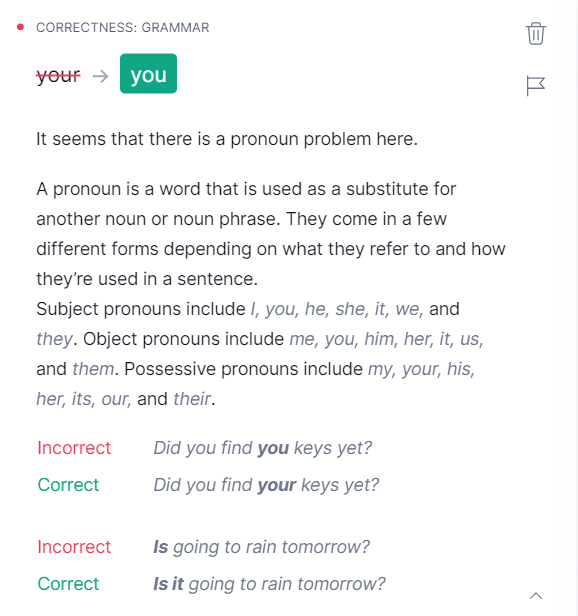
Grammarly (affiliate link) is a powerful grammar checker that provides tools to help you improve your writing. It’s a writing assistant that follows you almost everywhere you want to write.

It proofreads your work and suggests corrections for errors. By providing an explanation for those corrections, it helps you learn from your mistakes.

Grammarly correction

The free version will help you with spelling errors and basic grammar mistakes and could be adequate for casual writers.

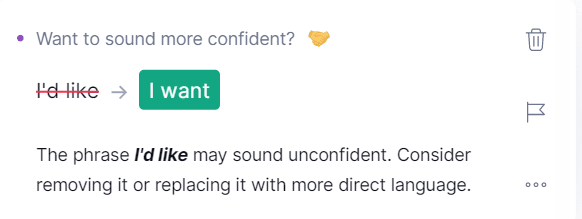
Grammarly Premium catches advanced grammar and punctuation mistakes and contextual spelling errors. It provides suggestions for improvements in sentence structure, word choice, and readability.

It even allows you to set goals for tone and intent, an experimental function, but it can be useful.

Grammarly style

Pros of Grammarly

  • Easy to use with a clean and simple user interface.
  • Unlimited plagiarism checks with Grammarly Premium.
  • The flexibility of multiple formats. It’s available as a web-based tool, web browser extension, desktop app, an add-on for Microsoft Word, or as a keyboard for your mobile devices.

Cons of Grammarly

  • The free version has limited features and will catch fewer errors than the premium version. You’ll need to upgrade to Grammarly Premium to gain access to Grammarly’s best features.
  • Google Docs integration is still in beta. You’ll need to copy and paste your text into the app to get the full benefit of your premium subscription.
  • Grammarly can be a bit aggressive in suggesting errors. For example, Grammarly loves commas even when they may interrupt the flow of a sentence.

How Much Does Grammarly Cost?

You can try Grammarly (affiliate link) for free.

The Grammarly Premium upgrade has three options: $29.95 per month billed monthly, $19.98 per month billed quarterly ($59.95), or $11.66 per month billed annually ($139.95).

Grammarly Review

The free version of Grammarly will catch typos and basic grammatical errors. The premium version will intercept advanced errors and provide feedback to help you improve your writing.

As noted in our in-depth review of Grammarly, it is an excellent choice to improve your writing skills and keep your writing error-free.

2. Ginger

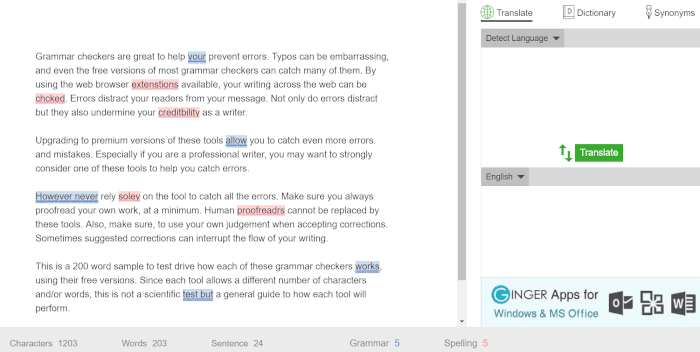
Ginger is an online grammar checker tool that corrects “all types of grammatical mistakes, including punctuation, sentence structure, and style.” It also provides translation into over 40 different languages. For example, you can write in German and then translate it into English.

The free tool is limited to 350 characters. However, if you are willing to sign up with Ginger, you can get a far more robust Google Chrome plugin for free. This will give you access to the Ginger Writer app, where you can copy and paste your text to find any errors.

Ginger writer app

Ginger has a mobile app, Ginger Keyboard, to catch spelling mistakes in texts, emails, and social media posts. It works with MS Word, but not Google Docs.

Pros of Ginger

  • It provides translations for over 40 languages, allowing you to communicate in multiple languages.
  • The free version includes three writing tools— an editing window with translations, a dictionary, and a thesaurus.
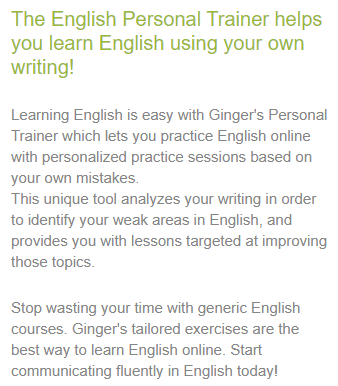
  • The premium version includes a “personal trainer” to improve your English. The trainer provides “personalized practice sessions based on your own writing.”

Cons of Ginger

  • Multiple steps to work through your text in the Ginger Writer app. First, you have to hover over mistakes to find out what is wrong. Then you need to click a text box to either accept or reject the error. There is no sidebar (like Grammarly), listing each potential mistake.
  • It provides minimal feedback about errors in the free version.
  • Ginger is not compatible with the Mac OS or Google Docs.

How Much Does Ginger Cost?

If you need more than the free version, upgrading to Ginger Premium has three options. $20.97 per month billed monthly, $7.49 per month billed annually ($89.88), or a two-year subscription for $159.84. Note these prices reflect a special promo discount of 30% off all plans.

Ginger Review

The free version of Ginger offers basic spelling and grammar checking. You’ll need to upgrade to the premium version for more advanced grammar checking or to see an analysis of your errors.

If English is your second language, or if you wish to switch between languages while also double-checking your grammar, Ginger is a great choice.

3. Hemingway Editor

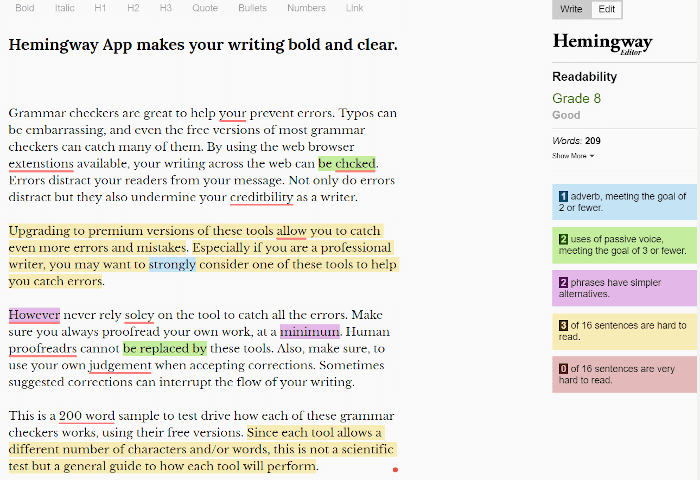
The Hemingway Editor is a style checker that provides feedback to keep your writing easy to read. Following the style of Hemingway, it aims for clear, simple sentence structures.

It labels complex sentences as either “hard to read” or “very hard to read.” This way, you can rewrite overly complex sentences that might trip up your reader.

It also flags the use of the passive voice, excessive adverbs, and complex phrases.

Hemingway Tool in action

Pros of Hemingway Editor

  • The online version is free.
  • If you get distracted when you write online, an inexpensive desktop version is available to help you avoid temptations.
  • Alerts you to writing that is either hard to read or understand that you might not catch on your own.

Cons of Hemingway Editor

  • You need to copy and paste your text into the app for it to review your work, and it won’t preserve your formatting.
  • It doesn’t provide suggestions on how to edit complex sentences. Fixing your text is up to you.
  • Following every suggestion could cause your writing to become TOO simplistic. Although you always want to be clear in your writing, sometimes, a bit of complexity is appropriate.

How Much Does Hemingway Editor Cost?

The online version is free. If you want to work offline, there is a desktop app available for $19.99.

Hemingway Editor Review

The Hemingway Editor is not a replacement for grammar checkers. But it is an excellent complement to them.

This app helps you enhance your readability and avoid the stumbling blocks that could cause your readers to bail. It can help ensure your writing gets read.

4. After the Deadline

After the Deadline is an open-source grammar checker tool.

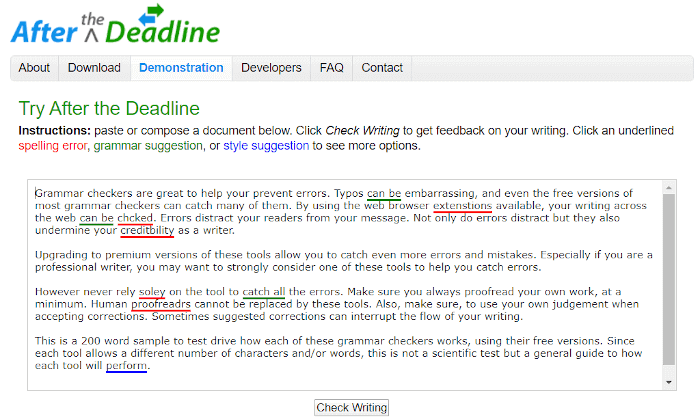
To quickly check a piece of writing for free, you can copy and paste it into the interface at polishmywriting.com. This tool provides feedback on spelling errors and provides grammar and style suggestions, as shown below.

AfterTheDeadline in action

After the Deadline is also available as a plugin for supported web applications, most notably WordPress.

Pros of After the Deadline

  • Free for personal use.
  • The English language isn’t the only option: a spell checker is also available in French, German, Portuguese, and Spanish.
  • You can install it as a WordPress plugin for grammar checking directly on your website.

Cons of After the Deadline

  • It has limited features compared to other grammar checkers.
  • You’ll have to click on each error to see what is wrong, and then select suggested fixes from a drop-down box.
  • It’s a super basic grammar checker, it missed contextual spelling errors and punctuation errors in a 200-word sample.

How Much Does After the Deadline Cost?

It’s free for personal use.

After the Deadline Review

If you’re a blogger who composes posts directly in WordPress, this free grammar checker can cut down on potential errors.

The open-source code is available for developers to use in applications.

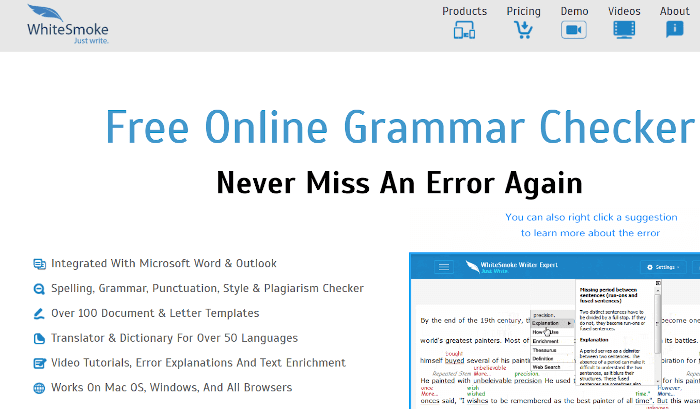
5. WhiteSmoke

WhiteSmoke will check your writing for spelling, punctuation, grammar, and style mistakes.

WhiteSmoke

It’s available in a paid web browser only version, which includes a grammar checker, plagiarism checker, and translator. The Premium version allows you to use WhiteSmoke with Windows, Mac, MS Office, and Gmail.

Pros of WhiteSmoke

  • An automated translator service, including over 50 languages (premium version only).
  • A plagiarism checker is available (500 credits with a subscription).
  • Over 100 document templates are available with the paid versions. Note, they also have an interesting “How to Write” section on their blog (for free!), with short blurbs on how to write many different types of documents.

Cons of WhiteSmoke

  • The free version is limited to 250 characters and is currently available as a web application only. The “free WhiteSmoke toolbar for Chrome” noted on their website was unavailable.
  • The web version works with web browsers only. You’ll need to upgrade to Premium to get support for all other formats.
  • No option for a monthly subscription. You’ll have to make the commitment to an annual subscription.

How Much Does WhiteSmoke Cost?

The Web version (browsers only) is $5 per month billed as $59.95 annually.

The Premium version is $6.66 per month, billed as $79.95 annually.

Note: these prices reflect a 50% discount.

WhiteSmoke Review

If you need a lower-priced grammar checker (while the 50% discount is valid), WhiteSmoke can save you money. But you have to be willing to take a chance as there is no free trial, although they do have a 31-day money-back guarantee.

6. LanguageTool

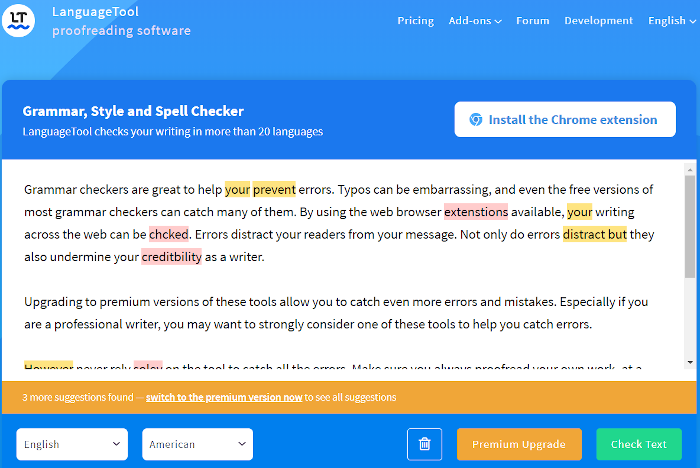
LanguageTool is an open-source, proofreading and grammar corrector tool that can fix spelling and grammar mistakes in more than 20 languages.

LanguageTool in action

It’s available in many formats:

  • As an online checker (shown in action above).
  • As add-ons for both Google Chrome and Firefox so you can check your writing across the web.
  • As add-ons for Google Docs, Microsoft Word (premium version only), and LibreOffice.

Pros of LanguageTool

  • It supports more than 25 languages besides English, including Spanish, French, and Russian.
  • It has a personal dictionary you can customize.
  • Developer API access is available (for software companies and publishing houses).

Cons of LanguageTool

  • The focus of this tool is simplicity, so it lacks the features of other grammar checkers.
  • The free version limits you to 20,000 characters per check (a word count of around 3,400 words, although characters per word vary significantly).
  • The premium version limits you to 40,000 characters per check, so you’d need to check very long documents in pieces.

How Much Does LanguageTool Cost?

If you need more than the free version offers, LanguageTool Premium has three options. $19 per month billed monthly, $13 per month billed quarterly ($39), or $4.92 per month billed annually ($59).

LanguageTool Review

LanguageTool is the right choice if you are looking for a basic spell checker with grammar checking capabilities. And it’s not just for English speakers — not only is there a free version, but LanguageTool can support other languages too.

However, languages are supported to different degrees. Check this table to determine how well supported your language is.

7. ProWritingAid

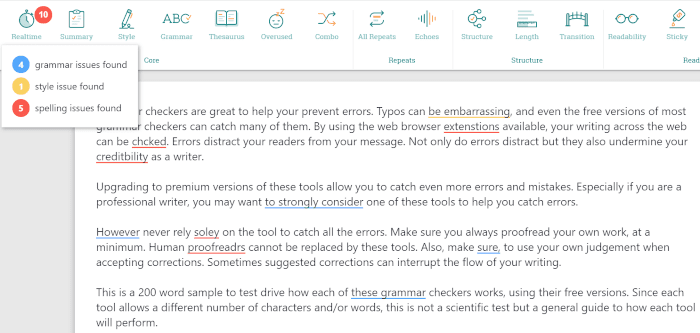
ProWritingAid is one of the more robust grammar checkers besides Grammarly. It flags grammar, punctuation, spelling, and style issues, and provides in-depth feedback on your writing.

ProWritingAid in action

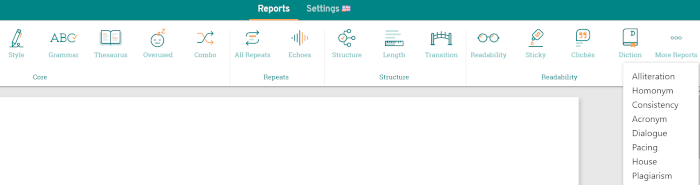
It has over 20 different writing reports, which you can click on one at a time, so you don’t need to do all your editing at once.

ProWritingAid reports

For example, you could first fix grammar, spelling, and style errors. Then you could select the report to change up any repeated words and phrases.

Next, you could run a report to identify cliches, and then follow up with a report on sentence structure issues.

Going through these reports will help you improve the quality of your writing. You can read through their suggestions and implement what works for you.

Pros of ProWritingAid

  • The variety of reports provided are excellent for self-editing.
  • A lifetime subscription offered at a reasonable price.
  • Integration with Scrivener is available.

Cons of ProWritingAid

  • The free trial is limited to up to 500 words in the online tool.
  • No monthly version is available. You need to commit for one year.
  • No mobile app versions are currently available for either iOS or Android.

How Much Does ProWritingAid Cost?

Upgrading to ProWritingAid Premium has four options: $70 per year, $100 for 2 years, $140 for 3 years, or a lifetime subscription at $240.

ProWritingAid Review

If you want extensive feedback on your writing, ProWritingAid is a solid choice. You have the option to view reports one at a time to avoid becoming overwhelmed by the quantity of feedback.

For fiction writers, the unique reports to check your pacing and dialog could be valuable.

8. Google Docs (or Microsoft Word)

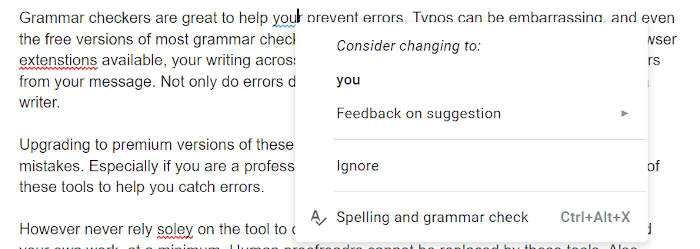
Both Google Docs and Microsoft Word include built-in grammar checkers. They allow you to fix your basic spelling and grammar errors for free.

As you type, a red squiggle under the word alerts you to spelling errors when you make them. A blue squiggle indicates potential grammar errors.

Right-click for suggested corrections (unless you are way off, in which case, you’re on your own!), and select the ones you agree with.

Google Docs at work:

Google docs

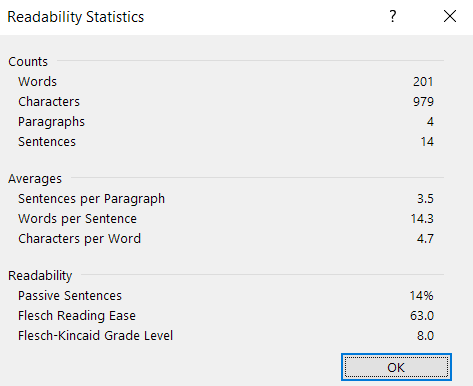
Microsoft Word also provides a quick snapshot of your text’s readability.

Microsoft Word Readability

Pros of Google Docs (or Microsoft Word)

  • Grammar and spell checking is included in the word processing software, so there is no need to copy and paste it into a separate tool.
  • Google Docs provides translation through Google Translate. You can translate your text into 100 different languages, for free!
  • Customizable dictionaries are available in both programs.

Cons of Google Docs (or Microsoft Word)

  • Neither program provides advanced grammar checks or style checkers.
  • The grammar checker functionality is limited to the programs themselves.
  • It can slow your writing down to edit while creating. You may want to turn off suggestions to avoid the start/stop process of writing and editing at the same time.

How Much Does Google Docs (or Microsoft Word) Cost?

There is no extra expense, the grammar and spell checkers are part of the software.

Google Docs (or Microsoft Word) Review

If you write using these word processors, their free spelling and grammar checkers provide the first line of defense against basic errors.

To correct more advanced errors, and get feedback on your writing, you’ll want to use a dedicated grammar checker.

Grammarly is the most well-known grammar checker, and we feel it is the best choice for most users. Yes, it isn’t perfect and can suggest odd things sometimes, but it will do its best to keep you out of trouble.

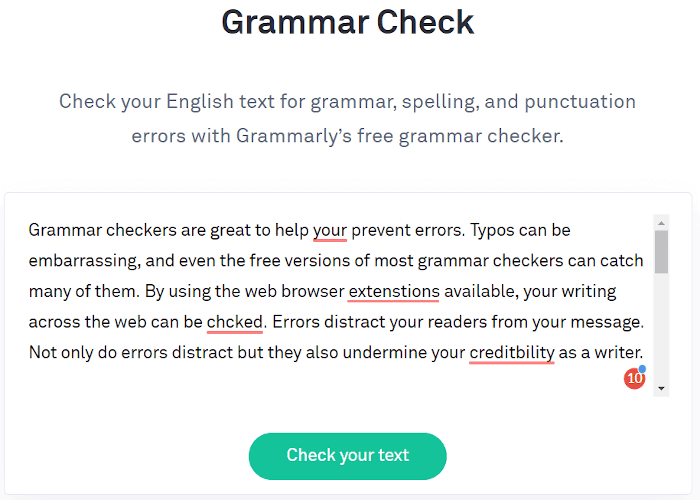
Here’s the free version of Grammarly in action:

Grammarly free version

And here’s the premium version:

Grammarly Premium in action

It is one of the easiest grammar checkers to use. It’s available in multiple formats, allowing you to use it almost everywhere you write.

However, other grammar checkers may have features not currently available in Grammarly, making them a better choice for some users.

Want to get an idea of those differences? Read on!

Grammarly vs. Ginger

Advantages for Ginger

  • Supplies translation tools, and includes support for over 40 languages.
  • The premium version offers English grammar lessons and tests to improve your English.
  • It has a text reader to convert text to a human voice, allowing better proofreading since you may hear errors you didn’t see.

Advantages for Grammarly

  • It provides an “at-a-glance” overview of errors it’s identified, listed out in a sidebar. Ginger requires you to hover over each error to learn more about it.
  • It makes the editing process faster. As you fix errors, Grammarly automatically toggles to the next one.
  • Unlimited plagiarism checks are part of the premium version.

Who Should Pick Ginger Over Grammarly

Ginger may be the better choice if you are multilingual. If English is your second language, Ginger has tools to help you learn more about English grammar. It also costs less than Grammarly, so budget-minded writers may want to take a closer look.

Ginger English Personal Trainer

Grammarly vs. Hemingway Editor

Advantages for Hemingway Editor

  • The online version is free, and the desktop app is inexpensive ($19.99).
  • It has a lower threshold for “complex sentences” than Grammarly, so if simplicity is essential, this tool will get you there.
  • It watches for overuse of adverbs, something Grammarly doesn’t offer.

Advantages for Grammarly

  • It is a full-featured grammar checker.
  • Grammarly provides suggestions on how to fix issues.
  • It’s customizable for writing styles. For example, you can select a formal writing style where “complex phrases” are acceptable.

Who Should Pick Hemingway Editor Over Grammarly

If you tend to write overly complex, or potentially confusing sentences, Hemingway Editor is an excellent tool. It identifies hard to read sentences so you can rewrite them. Fixing those messy sentences is up to you, but being aware of them is essential.

Instead of picking Hemingway Editor over Grammarly, you would want to use it with it (or another grammar checker).

Grammarly vs. After the Deadline

Advantages for After the Deadline

  • It’s free for personal use.
  • Blogging friendly — it’s designed to work well with WordPress, a useful feature for bloggers.
  • It provides spell checking for French, German, Portuguese, and Spanish.

Advantages for Grammarly

  • It is a far more powerful and feature-rich grammar checker.
  • A mobile version is available.
  • Grammarly provides reports containing feedback on your writing.

Who Should Pick After the Deadline Over Grammarly

After the Deadline could work for cash-strapped writers looking for free alternatives. Although it lacks the features of Grammarly, it can catch basic spelling errors and gives some feedback on grammar mistakes.

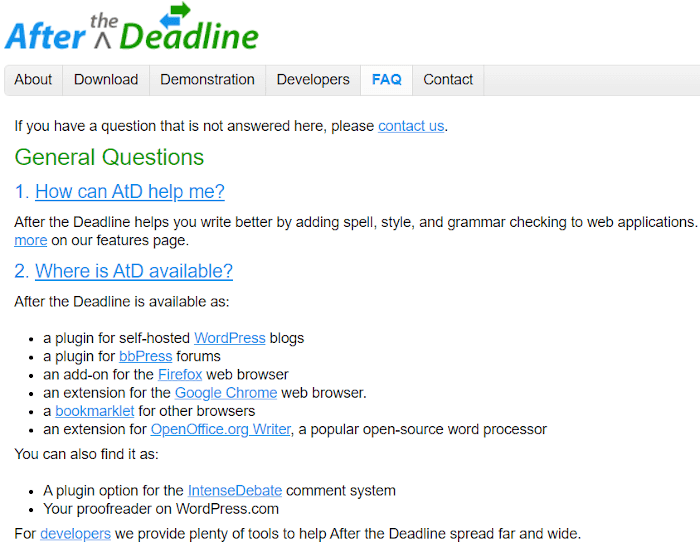
Here’s a snapshot of where and how you can use After the Deadline.

Afterthedeadline availability

Grammarly vs. WhiteSmoke

Advantages for WhiteSmoke

  • It provides translations for 55 languages.
  • The yearly subscription with a 50% discount currently costs less than Grammarly’s annual subscription.

Advantages for Grammarly

  • A free version is available, so you can try before you buy.
  • The free version works almost everywhere. You’ll need the premium version of WhiteSmoke to use it beyond web browsers.
  • Monthly and quarterly plans are available.

Who Should Pick WhiteSmoke Over Grammarly

Budget-minded writers who can take advantage of the 50% discount and are willing to pay for an annual subscription without a free trial.

Grammarly vs. LanguageTool

Advantages for LanguageTool

  • It provides multilingual support — it finds errors in other languages besides English.
  • Developer API access is available for this grammar checker.

Advantages for Grammarly

  • Unlimited error checking (no limits on characters per check).
  • You can set writing goals based on the type of writing you do. For example, formal writing requires stricter grammar rules than casual writing.
  • It has tools to improve the readability of your writing.

Who Should Pick LanguageTool Over Grammarly

If you write in another language besides English, and your language is fully supported, you may want to consider LanguageTool. For example, the premium version of LanguageTool will detect the wrong gender in salutation in German.

Grammarly vs. ProWritingAid

Advantages for ProWritingAid

  • ProWritingAid provides extensive writing feedback — over 20 writing reports are available.
  • It has Scrivener integration. Especially valuable for book authors, there is no need to copy and paste into a separate tool to check your writing.
  • A lifetime subscription option, freeing you from recurring payments.

Advantages for Grammarly

  • Unlimited plagiarism checks are available in Grammarly Premium.
  • Grammarly Keyboard is available for mobile, for both iOS & Android. (ProWritingAid does not currently offer grammar checking for mobile).
  • The error checker is faster.

Who Should Pick ProWritingAid Over Grammarly

Writers who are looking for detailed feedback on their sentence structure and style. Also, fiction writers may find ProWritingAid a better choice due to reports on story pacing and the tools to improve their dialog.

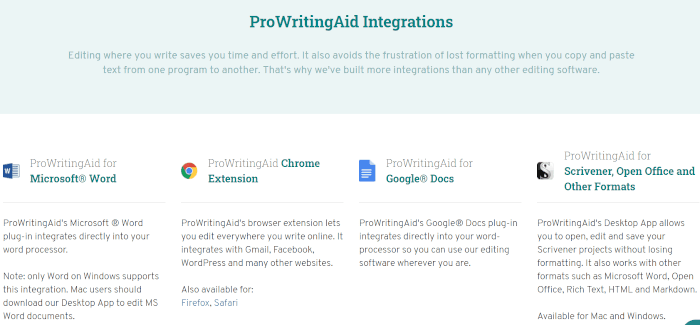
Scrivener users may prefer ProWritingAid due to the integration feature (versus having to copy and paste the text into an app).

ProWritingAid Integrations

Grammarly vs. Word Processors (Google Docs & Microsoft Word)

Advantages for Google Docs (or Microsoft Word)

  • It’s a free, built-in feature of popular word processing software.
  • Google Translation capabilities offered in Google Docs.
  • The desktop version of Microsoft Office allows you to work offline.

Advantages for Grammarly

  • It’s a full-featured spelling, grammar, style, and punctuation checker.
  • It provides feedback on why your errors are being flagged, which you can use to improve your writing.
  • It isn’t limited to word processing software, it’s available across the web or on mobile.

Who Should Pick Google Docs (or Microsoft Word) Over Grammarly

The spelling checker and grammar checker included with Google Docs (or Microsoft Word) are free and easy to use, so you should use them to avoid basic errors. However, those checkers cannot replace a dedicated English grammar checker such as Grammarly.

Google Docs does provide translation capabilities, something Grammarly doesn’t have.

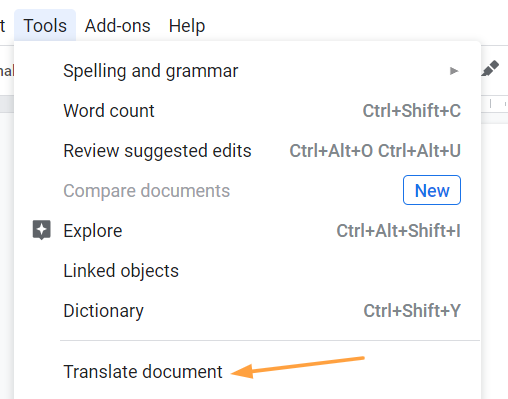
Google Translate under tools

So Which One is the Best Grammar Checker?

The best grammar checker for you depends on the features you need and on your budget.

There are free grammar checkers and free versions of premium grammar checkers, and those may be enough for casual writers. But they are limited compared to the premium versions.

Anyone dedicated to the craft of writing should strongly consider a full-featured premium grammar checker.

Grammar checkers are not a replacement for a human proofreader or an editor. They help cut down significantly on errors but are not enough by themselves. Always use human eyes for final proofreading.

Also, don’t rely solely on the suggestions provided by these grammar checkers. Instead, use your own judgment.

The best grammar checkers will significantly cut down on the number of errors you make. And error-free writing is essential.

So select a grammar checker to try and get started today.

About the Author: Karen MacKenzie is a freelance writer and Smart Blogger Certified Content Marketer. She blends her business and financial experience with a desire to connect with readers in a warm and friendly manner. Go to kmackenziewriter.com if you’d like to hire her for your next project.

The post 8 Best Grammar Checkers (2020): Grammarly, Ginger, & More appeared first on Smart Blogger.


from
https://smartblogger.com/best-grammar-checker/

Wednesday, February 19, 2020

How the Fastest-Growing US Companies Are Using Social Media

The fastest-growing companies in the United States are using social media to achieve a wide-range of goals, including to brand build and to generate sales, according to recent research published by The Center for Marketing Research. Read the full article at MarketingProfs

from
https://www.marketingprofs.com/charts/2020/42445/how-the-fastest-growing-us-companies-are-using-social-media

Friday, February 14, 2020

James Altucher – How to Start a Personal Brand that Matters [PODCAST]

In this episode of the “Break Through the Noise” podcast, I’m talking to James Altucher.

If you’ve ever wanted to dive into starting a personal brand that matters…

If you want to know how to affect people in a meaningful way…

This episode is for you.

Where to Subscribe

How You Can Support the Podcast

Leave us a Review

The more reviews we receive on Apple Podcasts and iTunes, the more listeners we’ll get to reach (thanks to Apple’s fancy algorithm).

If you don’t know how, click here for detailed, step-by-step instructions that’ll show you how to leave us a review on Apple Podcasts and iTunes.

Tell Your Friends & Family

Have friends or followers you believe would enjoy the podcast? Here are a couple quick and easy ways to share it with them:

Tweet This Episode:

In this episode of the 'Break Through the Noise' podcast, Jon Morrow talks to the great James Altucher. It's a must-listen.Click To Tweet

Share the Episode on Facebook:

The post James Altucher – How to Start a Personal Brand that Matters [PODCAST] appeared first on Smart Blogger.


from
https://smartblogger.com/podcast-james-altucher-how-to-start-a-personal-brand-that-matters/

Thursday, February 13, 2020

26 Creative Writing Exercises That’ll Punch Up Your Writing

Creative writing exercises are a great way to train your writing muscles. Ready to flex? Read on.

Wouldn’t you love to smash your content out of the ring every time?

To always land that knockout blow, just like your writing idols?

Imagine having the same audience of cheering fans, clamoring to read your next post (or to buy your first book as a published author).

Yep. That’s the dream, alright.

But let’s face reality. When you sit down to write new content, it never quite measures up to the greats. (How do they make it look so easy?)

You’d love to write like the heavyweight blogging champions that inspired you to start a blog in the first place, but right now you feel more like the puny guy at the punching bag. You may as well grab another soda and flop in front of the TV.

But don’t throw in the towel just yet.

You may not write like those blogging champions now, but that doesn’t mean you never will. If you exercise your writing muscles, you too can make money blogging and become one of the greats.

Creative Writing Exercises That’ll Punch Up Your Writing

How to Exercise Your Writing Muscles and Become a Blogging Heavyweight

Exercise. (Groan.) Who needs it?

You do. We all do.

If you want to be physically fit, you need to exercise your body. And if you want to produce powerful, punchy content, you need to exercise your writing muscles. It’s a no-brainer.

But that doesn’t mean you just write every day without any training regimen.

Sure, that might get you there eventually, but smart writers will exercise with precision.

They will take 15-30 minutes every day to train specific skills. And they won’t just train once and think they’re done. They will go back and train the same skill over and over, until they have it down pat.

That’s how you want to approach the writing tips below.

When you do them for the first time, you might feel clumsy and unnatural. But after a few weeks of daily workouts, you’ll quickly notice a difference.

That’s how exercise works.

Ready to get started?

Then put down that soda, buddy. We’re going to the writing gym!

6 Writing Exercises That’ll Make You Fearless in the Writing Ring


Most writers hold back when they write. They’re afraid to open up and show all of themselves, terrified they’ll be rejected or ridiculed. And if it’s a paid writing assignment for a client? Forget about it. It’s a recipe for writer’s block and staring at a blank page.

The most powerful writers are fearless. They bleed everything they have onto the page, making people wince, gasp, sob or seethe. Their writing connects on a deep level because they’re not scared to be vulnerable.

If you want your writing to connect like that, you must train yourself to release your suppressed emotions and write with brutal honesty.

powerful writers are fearless

It’s hard to put all of yourself out there, but once you master the technique, it’s like unshackling the chains. You will connect with your readers on an entirely new level.

The creative exercises below will train you to be fearlessly vulnerable.

1. Tell Your Best Friends Why They Suck

I’m sure you love your friends dearly, but let’s be honest, sometimes they annoy the heck out of you.

Write a letter to each of your friends, telling them what you hate about them. Tell them everything you wish they’d stop doing and saying.

Don’t actually send it — I don’t want to be responsible for ruining all your friendships — but don’t hold anything back.

And when you’re done, move on to family members, coworkers, and so on.

2. Confront the First Person Who Broke Your Heart

Write them the letter you’ve been penning in your head since the day they reached into your chest, ripped out your heart, and left it bleeding at your feet.

Tell them about the physical pain and every emotion you felt at that moment. The ones that are seared into your brain forever.

3. Recall Your Most Painful Experiences

Think about the most painful experiences in your life — the ones that didn’t just make you shed a tear or two, but made you bawl bucketloads.

Try freewriting them. Write an account of those occasions and let all the emotions flood out.

You should be dripping tears onto your keyboard while you do this.

4. Confess Your Deepest, Darkest Secret

Write about a secret that you’ve kept locked away out of embarrassment — something about yourself that nobody knows and that you don’t want anybody to know. Now’s the time to unleash the beast.

Remember, whatever you write is for your eyes only, and once you’re done, you can tear it up right away.

5. Write Down the Worst Thing That Could Ever Happen

What’s that one thing that you constantly worry will happen? What’s that one recurring nightmare that makes you wake up screaming and sobbing?

Whatever it is, write about it. Get it all on the page and face your monsters.

6. Describe Your Most Mortifying Moment

Everyone has a moment they wish they could erase. The shame and indignity of something you said or did. The toe-curling embarrassment that still makes you groan in agony whenever the memory pops into your head.

Put it down in writing. Remember every mortifying detail. Relive the humiliation and spew it all onto the page.

6 Writing Exercises That’ll Get Your Writing Style in Perfect Shape


When you talk, you use more than your voice. You use inflections, hand gestures and body language to add emphasis and personality. But as a writer, your words must have power. Each one has to count.

Your content shouldn’t just get the message across, it should do so with flair and gusto. It should be so pleasing to read that readers flow from line to line.

write with flair and gusto

That’s why every serious writer should spend serious time honing their writing style until it’s almost flawless.

1. Copycat Your Writing Heroes

One of the best ways to develop a strong writing style is to copy your favorite writers by hand — as in, pen to paper.

Pick a blogger or bestseller whose voice you admire and copy their content, word for word. Don’t think too hard about it. Just go with it.

As you write out their words, you’ll internalize their writing style, their pace and rhythm, their grammar, their word choice, and their sentence structure.

Make no mistake. This is one of the most powerful ways to sharpen your writing skills.

2. Replicate the Rhetoric from JFK and MLK

Famous speeches, like those from John F. Kennedy and Martin Luther King, often use rhetorical devices to strengthen their message.

See this example, where JFK repeats the same phrase at the beginning of each sentence.

 What we need in the United States is not  division.  What we need in the United States is not  hatred.  What we need in the United States is not  violence and lawlessness; but is love and wisdom and compassion toward one another.

Or see this example, where MLK uses several rhetorical devices in a row:

 When we let  freedom ring,  when we let  it ring  from every village and every hamlet, from every state and every city , we will be able to speed up that day when all of God’s children,  black men and white men, Jews and Gentiles, Protestants and Catholics , will be able to join hands and sing in the words of the old Negro spiritual,  “Free at last! Free at last!  Thank God Almighty,  we are free at last! 

These are marvelous writing tools you can use to make your content explode with power.

To get a good feel for them, google the transcripts of famous speeches, see if you can spot where they use rhetorical devices like the ones above, and then rewrite them to fit into five different contexts.

For example, you might rewrite JFK’s words as such:

What we need as [GROUP] is not [BAD THING #1]. What we need as [GROUP] is not [BAD THING #2]. What we need as [GROUP] is not [BAD THING #3]. What we need is [GOOD THING.]”!

The goal of this exercise is to practice these techniques until your brain absorbs the rhythm and inflection and it becomes second nature to recognize where to include rhetorical devices in your writing.

3. Eliminate 20%

Rambling sentences are a turn-off. Powerful content uses short and pacey sentences that are easy to read and simple to grasp.

That’s why you should train yourself to write concisely.

Select one of your old posts and rewrite it, paragraph by paragraph. Your goal is to cut around 20% of your total word count without changing the meaning or deleting a point.

Focus on shortening each paragraph itself. Cut flabby words, remove redundancy, merge sentences, and replace long-winded phrases with shorter alternatives. You won’t be able to do it for each one, but try.

Do this enough, and eventually conciseness will become a natural part of your writing process.

4. Write Your 400-Word Life Story

Nobody likes reading posts that go off on endless tangents and drag on and on about irrelevant nonsense.

You need to train yourself to omit the fluff and get to the point. You should only ever share the minimal amount that’s needed for the reader to get the picture.

In this exercise, write a story that paints a complete picture of your life, but limit yourself to 400 words. This forces you to focus on the most important events.

You can repeat this exercise with different topics as well. For instance, you might write a 400-word summary of the last movie you watched or the last nonfiction book you bought on Amazon.

5. Write a Movie Dialogue

You don’t want your content to read like an instruction manual. It should read like you’re having a conversation with your readers. This makes them feel more engaged with the content.

Writing fiction can help with this. So, before you write your next post, write a dialogue between yourself and an audience member on the same topic.

Think about how two people would chat (like in the scene of a movie), and reflect this natural flow in your writing.

6. Find Analogies for Everyday Life

Want to be a better writer? Analogies (and their cousins, similes and metaphors) are a writer’s best friend.

They can create powerful imagery, make complex ideas easy to understand, and add color and fun to your writing. But coming up with a great analogy is hard — unless you consistently practice writing them.

So make a list of everything you did or experienced yesterday such as getting up from bed, brushing your teeth, walking the dog, doing yoga, and so on. Now, for each activity, come up with a metaphor or analogy.

For example:
  • Every day I get up, I feel like a zombie. Some dark and evil force (the alarm) wakes me from my ‘rest in peace’. I claw myself out from under the covers and shuffle to the kitchen, moaning and probably drooling a little. I have only one drive at that moment: I must eat (breakfast, not brains), and I won’t stop until my hunger is sated.
  • Brushing with an electric toothbrush is like taking your teeth to the carwash. You push the brush onto each side of your teeth until they’re clean and then you rinse.

Training your brain to make connections between two unrelated things will get your creative juices flowing and make you more imaginative. Practice it enough and you’ll find that metaphors and similes will come to you naturally as you write your posts.

Hint: Finding great analogies is crazy-hard. Use this guide to make sure you’re doing it right.

2 Writing Exercises That’ll Give Your Writing a Hilarious Left Hook


Your content shouldn’t just teach and inspire your audience, it should also entertain. And sprinkling in the odd joke here and there can go a long way.

Humor helps you connect with your audience. It makes your content stand out in what may be an otherwise humorless niche, and this means it’s more likely to be remembered.

Don’t worry — you don’t have to become the next Jerry Seinfeld. But with these exercises, you can train yourself to find the funny in the mundane.

1. Look at the World Through Distorted Glasses

One reliable way to make people laugh is to put everything in the world into new and absurd contexts.

You pretend you don’t know what an object or custom is actually for, and then guess at what its true purpose is.

For example, you might look at an iPad and decide it’s a:
  • Frisbee for square people
  • Skating rink for mice
  • Chopping board for the insanely wealthy

See how that works?

Don’t worry about sounding silly. The trick is to think completely outside the box.

2. Pile on the Exaggeration

Another good way to go for laughs is to exaggerate something to the point of absurdity.

If you want an example of this in action, see this video of Phyllis Diller talking about her mother-in-law:

Get the picture?

Good. Now brainstorm twenty endings to each of these sentences:

  • My house is so small…
  • My cat is so lazy…
  • My wife is so bossy…
  • My home town is so hick…
  • My job is so boring…

Don’t worry if they’re not all comedy gold. The idea is to practice. The more you do it, the easier it becomes.

And when you’re done with this list, continue practicing. Use things you own or people you know, define a few of their characteristics (e.g., my car is red, tiny, old, guzzles gas, has powerful brakes, etc.), and then make a list of exaggerations.

4 Writing Exercises That’ll Beef Up Your Scene-Painting Skills


Dry content is boring. If you want to evoke a powerful response, you must evoke your reader’s senses.

You must paint tangible scenes, using visual and sensual language to make your words burst off the page in glorious technicolor.

writing that evokes a powerful response

Take this extract from one of Jon Morrow’s most inspiring posts, An Open Letter to Writers Struggling to Find Their Courage. It’s chock-full of words that paint a graphic picture of a fish:

Have you ever watched a fish suffocate?

You go fishing one day with your rod and reel, hook a fish, and reel it in, dragging it out of the water so you can get a better look at your catch. It’s lying on land, its gills pumping furiously, its eyes bulging, its mouth opening and closing in silent screams. Every once in a while, it flips around, trying to work its way back into the water, but it’s no use; the poor thing is hooked.

Minutes pass, and you can see the strength slipping out of it. It fights less and less, its eyes dull, and eventually, it goes still.
Jon Morrow

When you read that, can’t you just see the fish flip-flopping in front of you?

Powerful, isn’t it?

Use these exercises to practice painting vivid scenes yourself.

1. Describe the Best (and Worst) Date You Ever Had

What were you wearing? Where did you meet up? What were the first words out of your mouth?

Describe your memories of the date, making them as vivid and tangible as possible.

Don’t tell us she was pretty. Tell us how her sparkling eyes made you tingle from head to toe. Make us picture the scene, hear the sounds, and feel your sensations.

2. Write About Meeting Your In-Laws for the First Time

Was it terrifying? Funny? Heartwarming?

Did your mother-in-law’s eyes laser your heart before her tongue lashed at your soul? Or was she as welcoming as fried chicken at a family barbeque?

3. Recall Your Most Vivid Memory of School

This one speaks for itself. So I’ll just give you an example of my own:

At primary school, I hated rice pudding with a passion. One day I refused to eat it, so my teacher refused to let me leave the table. It was a battle of wills. I sat, arms crossed, staring at the cold, congealed, white mush, with cheap jelly splodged across its yucky skin. Beside me, my teacher cajoled, pleaded, threatened, and silently cursed. I won.

What’s your most vivid memory of school? Describe every detail.

4. Write About Your Greatest Sporting Moment

Write an account of your most glorious sporting achievement, whether you’re an Olympic champion, or you and your brother won the under-fives’ three-legged race at your community fair.

Relive every triumphant moment as you realized you were about to make your own personal version of sporting history.

3 Writing Exercises That’ll Make You Pack a More Persuasive Punch


Your writing must be persuasive if you want it to stick in people’s minds.

It must persuade your readers to see your point of view. It must persuade your readers to believe in themselves. Sometimes, it must persuade readers to buy what you’re selling.

So here are some exercises to practice your persuasion skills.

1. Give Your Younger Self a Pep-Talk

Everyone is a work in progress, which is why one of the best ways to persuade people is to show them a better version of themselves. If you can inspire someone, you can persuade them.

But not everybody is naturally inspirational. That’s why you should practice.

You must have had moments in your past when you could’ve used some words of encouragement — moments when you felt scared, or concerned, or defeated.

Find these moments in your life, and write your younger self a pep-talk. Write down what you needed to hear in that moment. Inspire your younger self to keep their head up and keep going. Show them that better version of themselves.

2. Write a Super-Slick Sales Page for a Dinner Plate

You may not have any products or services on offer yet, but at some point, you probably will. That means you won’t just have to know how to sell, but you’ll have to get over whatever hangups you have about being “salesy.”

Pick an object from your house — something mundane, like a dinner plate, a pencil, or a towel — and write an over-the-top sales pitch for it.

Think about the benefits of the object, and what features it has that makes it stand out against other similar objects. By picking a mundane object, you force yourself to get creative when you think of its unique selling points.

3. Write an Assertive Op-Ed Piece for the New York Times

When you write a blog post, you must write with authority. That means you can’t be wishy-washy with your language and you can’t hold back your opinions because you’re afraid they might rub people the wrong way. (Remember, you have to be fearless.)

Train yourself to be assertive in your writing by picking a controversial topic you feel strongly about and pretending the New York Times asked you to write an op-ed on it.

State your opinion clearly and proudly, avoid ambiguity, and explain in no uncertain terms why you feel the way you feel.

5 Writing Exercises That’ll Strengthen Your Storytelling Muscles

Everyone loves a good story. And understanding the mechanics of telling a good story will make you a far more engaging writer.

Did you know, for instance, that most great stories follow a three-act structure?

It typically breaks down like this:
  • Act 1: The Set-Up. This act introduces us to the hero and the world they live in. It sets up the status quo and sets up the story’s main conflict by giving the hero a problem to solve or an antagonist to beat.
  • Act 2: The Confrontation. The hero confronts the problem. This act also typically includes the hero gathering the skills, tools, and/or alliances they need to confront the problem.
  • Act 3: The Resolution. The hero solves the problem. Their world has changed for the better.

When you do the exercises below, try and mix things up by writing shorter and longer stories. Write a multi-page story, then write a three-paragraph story. But apply the three-act structure every time, until you have it down pat.

1. Write Your Own Superhero Story

Imagine you’re a superhero who has to save the world from a terrible evil. Use your real life for inspiration, but sprinkle in fantastical elements to make things more exciting.

Where do you come from? What’s your superpower? Who or what gave you your powers? What’s your kryptonite? Who’s your evil arch-enemy?

Have fun with this one!

2. Write a Series of Café Stories

Sit in a café and observe the people around you. Pick someone who looks interesting. Now, use every ounce of your imagination and write his or her story.

What brought them to this coffee shop? Are they in the first act of their story and about to set off on an adventure, or are they in the third act and recuperating from the adventure they had?

3. Write Crime Thrillers About Your Neighbors

Did you ever see the movie Rear Window? Or have you read this year’s literary thriller, The Woman in The Window? Both follow a similar compelling storyline of someone witnessing a crime in a neighboring house… or did they?

Next time you’re walking your dog around your neighborhood, pay more attention to the homes you pass. Now write a synopsis of a short thriller inspired by any of the houses you see (or can see into). Let the front yard, architecture, and possibly the people drive your twisted tale.

4. Write a Graveyard Tale

Go to your local graveyard and wander around the tombstones. Take inspiration from the inscriptions and write a series of short stories about the characters you find.

How did they die? Who did they leave behind? Are they connected to anyone else in the graveyard?

5. Write a Fairy Tale about the Big Bad Wolf

Think of your favorite fairy tales (Little Red Riding Hood, Snow White, Hansel and Gretel) and rewrite them from the bad guy’s point of view.

Put yourself in their shoes. Think about what motivated them, what they were trying to achieve, and whether they cared what other people thought of them.

Do the same for each of the main characters in the story (e.g., the mom, the grandma, the woodcutter). And finally, create a new disinterested observer and write the same fairy tale from their point of view.

This will teach you to think more deeply about character development in your stories.

Which of These Creative Writing Exercises is Your Favorite?

You made it!

You’ve completed a full run-through of your writing workout.

All you have to do now is start practicing these exercises for real.

Every day. Every week and every month.

Find two or three exercises or creative writing prompts that appeal to you and start a regimen for 15-20 minutes a day. After a couple of weeks, pick another two or three and start again.

Keep refreshing them. Keep enthused and keep at it.

Before you know it, you’re going to go from that puny guy at the punching bag to heavyweight writing champion of the world.

Yeah! (Cue Rocky music!)

About the Author: Mel Wicks is a seasoned copywriter and marketing strategist who helps bloggers and entrepreneurs put the ‘OMG! Where do I sign up?’ into everything they write. Build your 6 major writing muscles with her free Writer’s Bootcamp infographic, and smash your content out of the ring every time.

The post 26 Creative Writing Exercises That’ll Punch Up Your Writing appeared first on Smart Blogger.


from
https://smartblogger.com/writing-exercises/

Saturday, February 8, 2020

How to Live in Paradise for Cheap and Get Paid to Write [PODCAST]

If you’ve ever thought about escaping to live in paradise, you need to listen to this episode.

Tim Ferriss’ book The 4-Hour Workweek (affiliate link) calls it geoarbitrage, living in a place expenses are low, but making your wages where payment is high. If you’ve never heard the term, this episode could change everything for you.

It was a life-changing concept for me.

Where to Subscribe

How You Can Support the Podcast

Leave us a Review

The more reviews we receive on Apple Podcasts and iTunes, the more listeners we’ll get to reach (thanks to Apple’s fancy algorithm).

If you don’t know how, click here for detailed, step-by-step instructions that’ll show you how to leave us a review on Apple Podcasts and iTunes.

Tell Your Friends & Family

Have friends or followers you believe would enjoy the podcast? Email them a link to this post. You could also…

Tweet This Episode:

'I really owe a lot to Tim (Ferris).' In this week's podcast episode, @jonmorrow talks about geoarbitrage. If you've never heard of it, it could change your life.Click To Tweet

The post How to Live in Paradise for Cheap and Get Paid to Write [PODCAST] appeared first on Smart Blogger.


from
https://smartblogger.com/podcast-how-to-live-in-paradise-for-cheap-and-get-paid-to-write/